Color Fastness Chemistry: Regulatory Compliance and Quality Control for Underwear Brands#
Why Non-Compliant Dyes Are Your Liability Nightmare#
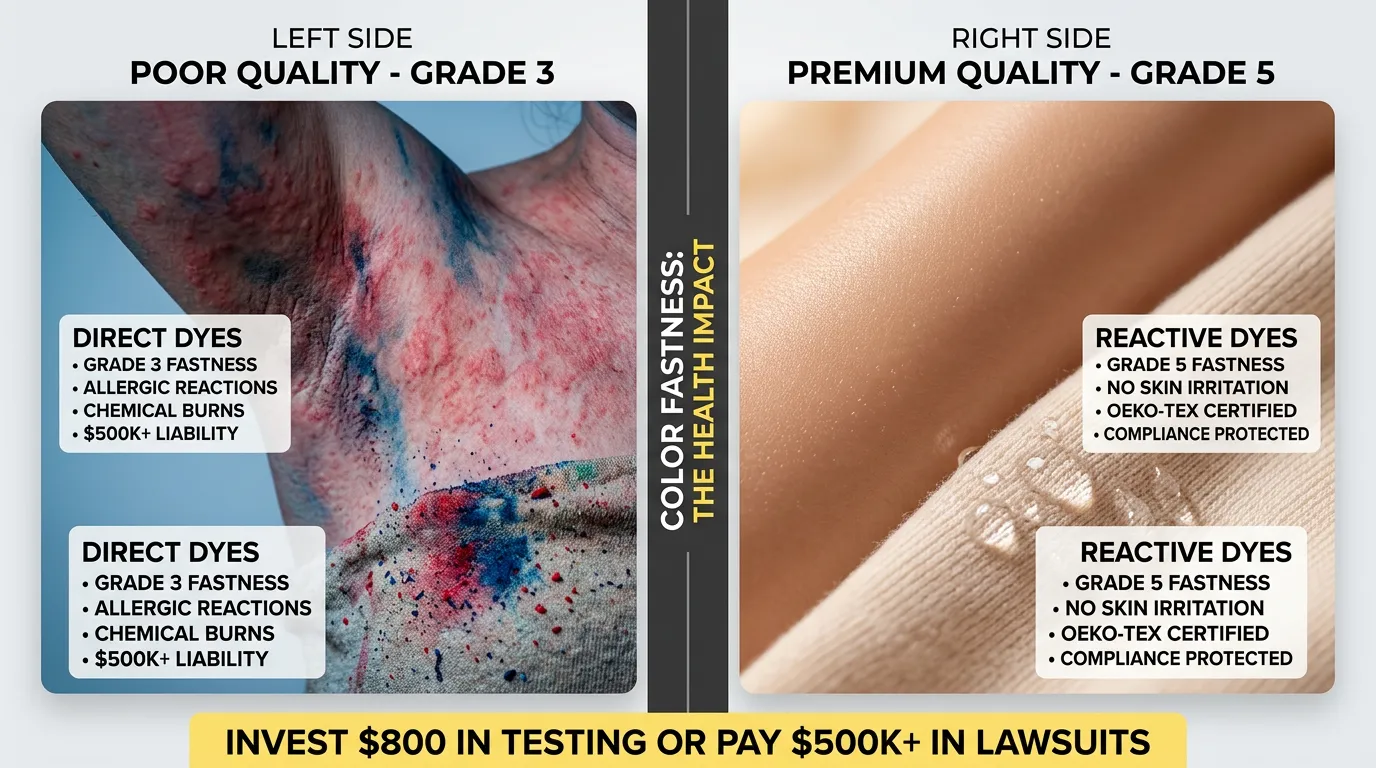
Poor color fastness isn't just a quality issue—it's a legal liability. When dark dyes bleed onto skin through sweat absorption, customers experience allergic reactions, chemical burns, and infections. The result? Lawsuits, recalls, and brand-destroying negative publicity.
As a brand owner, you need to understand that dye chemistry and regulatory compliance are non-negotiable. Different markets have different chemical restrictions, and non-compliance can result in customs seizures, product recalls, and six-figure legal damages.
For DTC underwear brands, color fastness isn't just about appearance—it's about liability protection and market access.
Quick Science Recap (For Context)#
For a deep dive into the science, read our original guide: Color Fastness: The Chemistry of Non-Fading Dyes
The key principles:
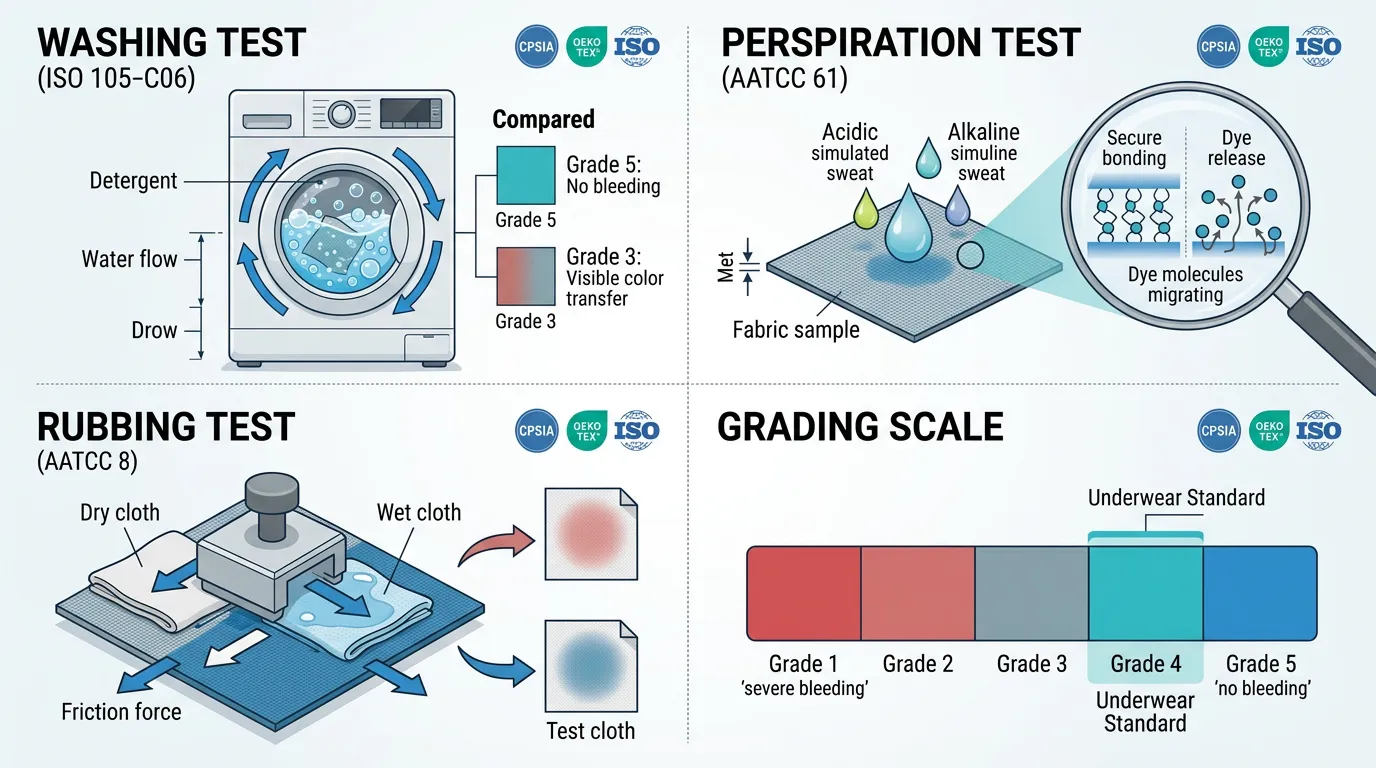
- Color Fastness Grade 4-5 is the minimum acceptable for underwear (sweat exposure)
- Reactive dyes form chemical bonds with fabric (better fastness than direct dyes)
- Dark colors require higher fastness grades (more dye = more migration risk)
- Sweat and friction accelerate dye migration onto skin
The Regulatory Landscape: Market-by-Market Requirements#
When sourcing dyed underwear, you must comply with the regulations of every market you sell to. Non-compliance doesn't just risk returns—it risks legal action and market exclusion.
Regulatory Requirements by Market#
Key Regulations: CPSIA, California Prop 65
Restricted Dyes: Azo dyes >30ppm, lead <90ppm, formaldehyde limits
Testing Required: Third-party CPSC-accepted lab testing
Penalties: $15,000+ per violation + product recalls
Enforcement: High (CPSC active enforcement, consumer lawsuits common)
Key Regulations: REACH Annex XVII, OEKO-TEX Standard 100
Restricted Dyes: 24+ carcinogenic azo dyes banned, heavy metals restricted
Testing Required: OEKO-TEX certification required for market access
Penalties: €20,000+ per violation + product destruction at customs
Enforcement: Very High (customs tests every shipment, market exclusion risk)
Key Regulations: GB 18401-2010 (National Basic Safety Technical Code)
Restricted Dyes: Decomposable carcinogenic aromatic amines banned
Testing Required: CNAS-accredited lab testing
Penalties: Product seizure, fines, factory license suspension
Enforcement: High (regular factory inspections, market surveillance)
Cost of Non-Compliance#
The lesson: Investing $500-1,000 in compliance testing per production run prevents $150,000-1,000,000+ in losses. Compliance is not optional—it's insurance.
Business Impact: The Health-Liability Connection#
Poor color fastness causes chemical burns and allergic reactions. When customers experience health issues from your product, you're liable for medical costs, damages, and legal fees.
The Health-Cost Connection#
The Hidden Cost of Non-Compliant Dyes:
Health Impact (per 10,000 customers with poor color fastness):
- Allergic skin reactions: 40-80 cases
- Chemical burns/dermatitis: 15-30 cases
- Heavy metal exposure (long-term): 5-10 cases
- Medical costs to customers: $200-1,000 per case
Legal Impact:
- Consumer lawsuits: 2-5 cases per 10,000 customers at $50,000-200,000 settlement
- Class action risk: High if systematic issue discovered
- Regulatory fines: $15,000-100,000 per violation
- Average legal cost: $500,000 per color fastness failure
Business Impact:
- Product recall: $50,000-200,000 (logistics + destruction)
- Market exclusion: Indefinite (REACH violations)
- Brand perception: "Unsafe," "chemical risks"
- Customer churn: 70-85% of affected customers never return
The ROI of Compliance:
- Investing $800 per production run in color fastness testing
- Prevents $500,000 in lawsuit liability and recall costs
- ROI: 62,400% return on compliance investment
Specification Guidelines: What to Put in Your Tech Pack#
When creating your tech pack, the dye and color fastness section must be detailed. Poor specifications = compliance violations.
Essential Color Fastness Specs#
Tech Pack Requirements:
Dye Specifications:
- Type: Reactive dyes (minimum) for cotton, disperse dyes for synthetics
- Prohibited: Direct dyes (poor fastness), azo dyes >30ppm (carcinogenic)
- Dark Colors: Grade 4-5 minimum (ISO 105-C06 wash test, AATCC 61 perspiration test)
- Light Colors: Grade 3-4 minimum (less dye migration risk)
Color Fastness Standards (Critical):
- Washing: Grade 4-5 (ISO 105-C06) – no bleeding after 50 washes
- Perspiration: Grade 4-5 (AATCC 61) – no bleeding in acidic/alkaline sweat
- Rubbing: Grade 4 (dry), Grade 3 (wet) – no transfer with friction
- Light: Grade 4 (ISO 105-B02) – doesn't fade in sunlight
Regulatory Compliance (Required):
- United States: CPSIA compliant, CPSC-accepted third-party lab report
- European Union: OEKO-TEX Standard 100 certification (mandatory for market access)
- China: GB 18401-2010 compliant, CNAS-accredited lab report
Testing Requirements:
- Pre-production: Lab dip color fastness testing (all standards)
- In-production: Bulk fabric testing before cutting (10% sampling)
- Final inspection: Color fastness spot test (AATCC test strip method)
- Documentation: Maintain certificates for 5 years (legal requirement)
Material Safety (Chemical Restrictions):
- Formaldehyde: <75ppm (infant), <300ppm (adult)
- Heavy metals: Lead <90ppm, cadmium <40ppm
- Azo dyes: Carcinogenic aromatic amines <30ppm (preferably 0)
- pH: 4.0-7.5 (skin-compatible)
Red Flags: What Indicates Compliance Risk#
When evaluating dye houses or factory capabilities, watch for:
Warning Signs of Color Fastness Compliance Risk:
- No OEKO-TEX Certification: Can't sell in EU without it – immediate market exclusion
- "Fastness Not Specified": Factory can't provide color fastness grade reports = liability risk
- Direct Dyes Used: Poor wash fastness – guaranteed bleeding after 20 washes
- Dark Colors Grade 3-4: Unacceptable for underwear – skin exposure through sweat
- No Third-Party Testing: Factory tests in-house = results can't be trusted
- Cheap Lab Dips: Suspiciously low dye cost = likely using prohibited chemicals
Manufacturing Process: From Tech Pack to Compliance#
Understanding how factories dye fabrics helps you avoid compliance disasters and legal liability.
Step 1: Lab Dip & Color Fastness Testing#
Timeline: 1-2 weeks
- Factory creates lab dips (color samples)
- Critical: Test lab dips for color fastness BEFORE bulk dyeing
- Test washing, perspiration, rubbing fastness
- You verify: Color match AND fastness grades (don't approve color without fastness data)
Factory Insider Tip:
Many factories create beautiful lab dips that match your color perfectly—but use direct dyes that bleed after 10 washes. Always require color fastness test reports with lab dip approval. A beautiful color that causes allergic reactions is a liability, not a product.
Step 2: Bulk Dyeing & Compliance Verification#
Timeline: 2-3 weeks
- Factory dyes bulk fabric (500-2000kg batches)
- Critical: Test first batch for full compliance (all standards)
- Obtain third-party lab reports (CPSC-accepted or OEKO-TEX)
- You verify: Fastness grades, chemical restrictions, regulatory compliance
- Only after compliance confirmed: Proceed to cutting and sewing
Step 3: Pre-Production Compliance Testing#
Timeline: 1 week
- Factory creates PP sample using bulk dyed fabric
- Send sample to third-party lab for compliance testing
- Critical: Don't proceed with production until compliance verified
- Maintain lab reports for legal documentation
Step 4: Production QC & Documentation#
Timeline: (during production)
- In-line QC: Verify fabric color consistency, check for dye spots
- Final QC: Retain 5 samples from each production run for testing records
- Documentation: Maintain all lab reports, certificates, and test data for 5 years
- Ship finished goods with compliance documentation (customs requirement)
Industry Terminology: What to Say When#
When communicating with factories about color fastness, use these industry terms:
Key Terminology:
- Color Fastness Grade: Rating 1-5 of color resistance to fading/bleeding. Grade 4-5 is minimum for underwear (sweat exposure).
- Reactive Dyes: Dyes that form chemical bonds with fabric—superior wash fastness compared to direct dyes.
- Lab Dip: Color sample created for approval before bulk dyeing. Must include fastness testing, not just color match.
- OEKO-TEX Standard 100: Certification ensuring textiles are free from harmful chemicals. Mandatory for EU market access.
- AATCC 61: American standard for testing color fastness to perspiration (critical for underwear).
- ISO 105-C06: International standard for testing color fastness to washing.
- CPSIA: Consumer Product Safety Improvement Act (US) – regulates chemicals in children's products.
- REACH: EU regulation restricting chemicals in textiles – non-compliance = market exclusion.
Quality Control: Testing Color Fastness#
Don't assume dyes are compliant. Verify with these tests:
Pre-Production Testing (Before You Commit)#
-
Color Fastness to Washing (ISO 105-C06):
- Wash fabric sample at 40°C with detergent
- Measure color transfer to adjacent fabric
- Pass: Grade 4-5 (minimal color bleeding)
-
Color Fastness to Perspiration (AATCC 61):
- Simulate acidic and alkaline sweat exposure
- Measure color transfer and fabric staining
- Pass: Grade 4-5 for both sweat types
-
Color Fastness to Rubbing (AATCC 8):
- Rub fabric with dry and wet cloth
- Measure color transfer
- Pass: Grade 4 (dry), Grade 3 (wet)
Production QC Testing (During Manufacturing)#
- Every dye batch: Test washing and perspiration fastness
- Every production run: Retain samples for future testing records
- Third-party verification: 10% of runs tested by CPSC-accepted or OEKO-TEX lab
Sourcing Decision Framework#
Use this framework when deciding on dye quality and compliance strategy:
Decision Matrix:
Budget Line ($8-12 retail):
- Use: Reactive dyes, Grade 3-4 fastness, basic compliance
- Target: Price-conscious customers, accept 5-8% fading complaints
- Risk: Moderate (US market only, avoid EU/CA)
- Cost: $500 testing per production run
Mid-Tier Line ($15-25 retail):
- Use: Reactive dyes, Grade 4-5 fastness, OEKO-TEX certification
- Target: Quality-conscious customers, minimal complaints
- Risk: Low (all markets accessible)
- Cost: $800 testing per production run
Premium Line ($30+ retail):
- Use: Premium reactive dyes, Grade 5 fastness, full regulatory compliance
- Target: Luxury customers, zero complaints
- Risk: Minimal (full liability protection)
- Cost: $1,200 testing per production run
Common Mistakes Brand Owners Make#
Mistake 1: Approving Lab Dips Without Fastness Testing#
Reality: Beautiful color doesn't mean safe color. Direct dyes look great initially but bleed and cause reactions.
Solution: Never approve lab dips without color fastness test reports (Grade 4-5 minimum).
Mistake 2: Selling in EU Without OEKO-TEX Certification#
Reality: Customs tests EU-bound shipments. Non-compliant dyes result in immediate seizure and market exclusion.
Solution: OEKO-TEX certification is mandatory for EU market access. No exceptions.
Mistake 3: Assuming Factory Testing is Sufficient#
Reality: Factory in-house testing can be biased or incomplete. Third-party testing is legally required.
Solution: Require CPSC-accepted (US) or OEKO-TEX (EU) third-party lab reports.
Mistake 4: Not Maintaining Compliance Documentation#
Reality: When lawsuits or regulatory issues arise, lack of documentation = automatic liability.
Solution: Maintain all lab reports, certificates, and test data for 5 years minimum.
The Bottom Line: Color Fastness = Liability Protection#
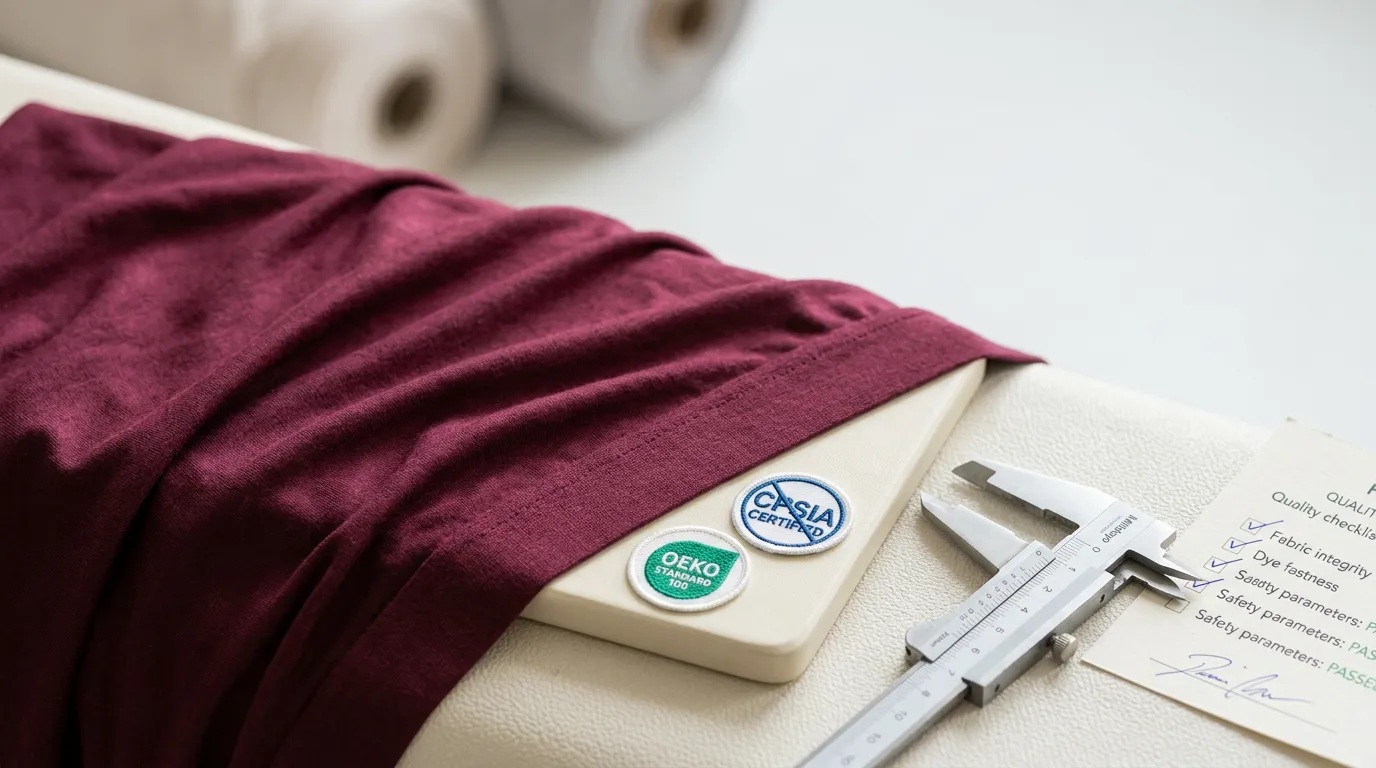
For DTC underwear brands, color fastness isn't just about appearance—it's about legal liability and market access.
When you get it right:
- Lawsuit risk: Minimal (full compliance documentation)
- Market access: Global (US, EU, China, etc.)
- Customer health: No allergic reactions or chemical burns
- Brand perception: "Safe," "quality," "trustworthy"
When you get it wrong:
- Lawsuit risk: High ($500,000+ average settlement)
- Market exclusion: EU/CA blocked permanently
- Customer health: Allergic reactions, chemical burns
- Brand perception: "Unsafe," "chemical risks"
- Result: $500,000-1,000,000+ in losses per compliance failure
The math is clear: Investing $800-1,200 per production run in compliance testing prevents $500,000-1,000,000+ in lawsuit liability, recall costs, and market exclusion losses. Compliance is not an expense—it's insurance.
Ready to Ensure Full Regulatory Compliance?#
Don't let non-compliant dyes destroy your brand with lawsuits and market exclusion. Whether you're launching a new line or ensuring existing products are compliant, understanding dye chemistry and regulatory requirements is critical to protecting your business and customers.
Get Expert Guidance:
- Compliance Checklist: Learn exactly what tests and certifications are required for each market
- Factory Matching: We connect you with dye houses and factories verified for compliance
- Tech Pack Review: We'll review your specs and identify compliance gaps
Contact Us to Get Your Compliance Checklist
Sources: This B2B guide is based on regulatory requirements from US CPSIA, EU REACH, and China GB 18401-2010 standards, OEKO-TEX certification requirements, AATCC and ISO color fastness testing standards, legal liability analysis from product liability cases, and manufacturing compliance best practices from China supply chain partners.