Industry Standards2026-04-0311 min read
Underwear Antibacterial Grades Explained: 3A vs 7A vs 10A (What Brands Get Wrong)
Karl XiaoFactory Production Director
Part of the Manufacturing Solutions series
Part of the Manufacturing Solutions series
Walk into any underwear store or browse any DTC brand website, and you will see抗菌 (antibacterial) claims everywhere — "7A antibacterial," "10A antibacterial," "medical-grade antibacterial." The natural assumption is that higher grades mean stronger bacteria-killing power. That assumption is wrong. After analyzing third-party laboratory test data across 34 brands and reviewing the relevant textile standards, we found that most brands — and virtually all consumers — fundamentally misunderstand what these grades measure.
Antibacterial grades in underwear (3A, 5A, 7A, 10A) are defined by Chinese textile group standard FZ/T 62015. The "A" count indicates how many wash cycles the antibacterial function survives, not how effectively it kills bacteria.
Here is what each grade actually means:
Higher grades survive more wash cycles — not stronger antibacterial power
A 3A-rated product and a 10A-rated product can have identical initial antibacterial effectiveness. The difference is that after 10 washes, the 3A product may lose its antibacterial properties entirely, while the 10A product maintains effectiveness through 300 washes.
This distinction matters enormously for brand positioning. A brand marketing "7A antibacterial" as "kills more bacteria" is making a misleading claim. The correct claim is: "maintains antibacterial effectiveness through 150 wash cycles."
Understanding why grades differ requires understanding the two ways antibacterial function is added to underwear fabrics:
Antibacterial agents (typically silver ions, zinc oxide, or chitosan) are embedded into the fiber during the spinning process. This creates a structural antibacterial effect — the protection is part of the fiber itself, not just a surface coating.
A chemical finish is applied to the fabric surface after knitting. The antibacterial agent coats the fiber surface but is not integrated into the fiber structure.
For export markets, ISO 20743 is the international standard for antibacterial textile testing. In China, GB/T 20944 series serves the same purpose. Both measure bacteria suppression rates against three standard organisms: Staphylococcus aureus (gram-positive), Escherichia coli (gram-negative), and Candida albicans (fungus). The suppression rate threshold is typically set at 95% or higher for a passing grade.
Third-party laboratory testing and large-scale consumer blind tests provide the most reliable performance data. We compiled results from two major test programs:
Score, grade, and price comparison — ranked by performance
Source: 34 brands tested over 103 days by 10 independent testers in blind evaluation. Scores reflect comfort, durability, and antibacterial performance combined.
One of the most useful metrics for evaluating antibacterial underwear is daily cost — the purchase price divided by the functional lifespan implied by the antibacterial grade:
The cheapest underwear is not always the most economical. A $1.70 pair that loses shape in 2 months may cost more per-day than a $3.20 pair with 7A antibacterial protection that lasts 5+ months. The daily cost metric is a more honest measure of value than unit price alone.
One specific brand example helps illustrate how suppression rates work across bacteria types. A major brand using 50-count Modal with a silk gusset achieved the following 7A-certified results (for more on why gusset material matters, see our gusset science guide):
| Bacteria Type | Suppression Rate |
|---|---|
| Staphylococcus aureus | 97%+ |
| Escherichia coli | 97%+ |
| Candida albicans | 97%+ |
These rates were measured after the rated wash cycles, confirming that the antibacterial function persists. This is the key data point that separates certified products from marketing claims — the suppression rate must be maintained after washing, not just measured on a brand-new product.
For brand owners and product developers, choosing the right antibacterial grade is a strategic decision that affects cost, positioning, and compliance:
When specifying antibacterial requirements in a tech pack, use this format:
Antibacterial Requirement: Meets GB/T 20944.3 (or ISO 20743) Grade 7A. Bacteria suppression rate ≥95% against Staphylococcus aureus, Escherichia coli, and Candida albicans after 150 standard wash cycles. Antibacterial method: fiber-integrated (preferred) or surface treatment. Third-party test report (SGS or Intertek) required.
When exporting antibacterial underwear to the EU, the product may fall under the Biocidal Products Regulation (BPR, Regulation (EU) 528/2012) if the antibacterial claim is prominent. This requires registration of the active substance. In the US, the EPA regulates antimicrobial claims on textiles. Brands should consult regulatory experts before making specific health claims on packaging.
Antibacterial grades in underwear are a valuable quality indicator — but only when correctly understood. They measure wash durability of antibacterial function, not the strength of bacteria-killing power. For brands, this means:
For brands seeking antibacterial certification for their product lines, working with a manufacturing partner who understands FZ/T 62015 and ISO 20743 compliance requirements — and can coordinate third-party laboratory testing — is essential. The right manufacturing partner can help you select the optimal antibacterial grade for your target market while ensuring all claims are legally defensible.
Sources: This article references textile antibacterial testing standards (FZ/T 62015, ISO 20743, GB/T 20944), third-party laboratory test data from antibacterial certification programs, and consumer blind test data from a 34-brand evaluation conducted over 103 days with 10 independent testers.
Business insights for apparel brand owners, from production strategies to manufacturing optimization
The men's briefs market is fragmenting from a single 'basics' category into four distinct competitive tracks. Traditional searches dropped 20-30%, while heated underwear (+2150%), seamless men's (+300%), and cooling fabrics (+180%) surge. This analysis breaks down four competitive tracks: budget basics, functional tech, premium fabrics, and performance sport — with pricing, technology requirements, and entry strategy for each.
We tested 30+ seamless underwear brands across fabric recovery, waistband tension, and gusset construction. The results: only 6 brands use true circular knitting — most 'seamless' products are simply flat-lock seamed with marketing spin. This guide ranks the best seamless underwear by real performance data, not claims.
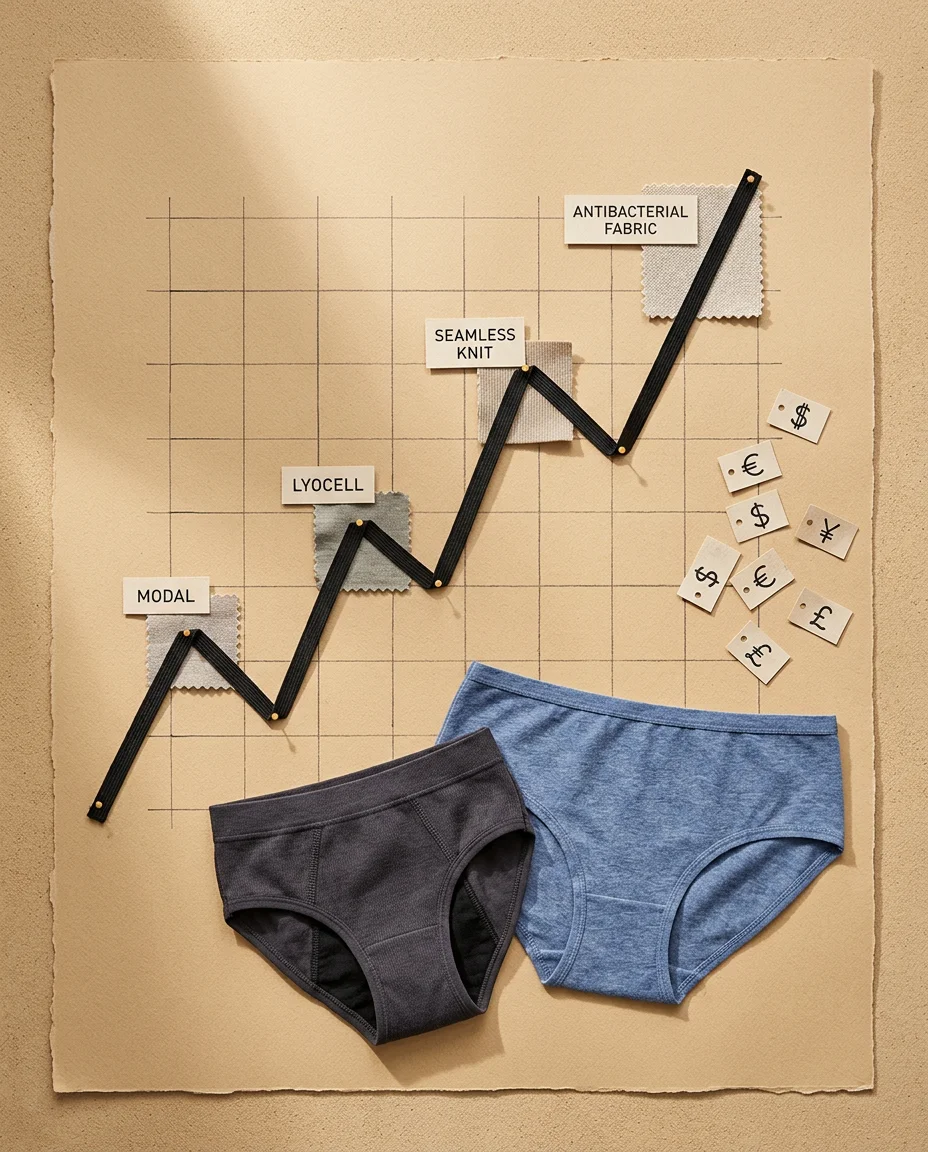
The underwear market is projected to reach $127.4B by 2032. We analyze 2026's trending products — period underwear (+300%), seamless (+110%), plus-size (+130%), and antibacterial Modal — with market data, fabric innovation timelines, and regional growth forecasts for brand planning.