Industry Trends2026-04-0714 min read
Trending Underwear Products 2026: $104B Market Analysis & Growth Data
Paul PengFactory Technology Director
Part of the Manufacturing Solutions series
Part of the Manufacturing Solutions series
The trending underwear products in 2026 are period underwear (brand searches +300%), plus-size underwear (+130%), seamless underwear (+110%), and antibacterial Modal with 7A-10A grades becoming the new baseline. The global underwear market stands at $92.30 billion (underwear/underpants) with e-commerce growing at 10.61% CAGR. Asia-Pacific leads with 48.25% market share; China alone accounts for $19.92 billion. Key fabric innovations include 100-count Modal (10-15 micron fiber diameter approaching silk), dual-layer composite gusset engineering for period underwear, and emerging smart underwear with biometric sensors.
The global underwear market is undergoing a structural transformation. According to FortuneBusinessInsights, the global lingerie market reached $48.59 billion in 2025 and is projected to nearly double to $104.55 billion by 2034, growing at a compound annual growth rate of 8.96% — roughly 2.5 times faster than the overall apparel market (3.52% CAGR). The broader underwear market is even larger at $92.30 billion. What makes 2026 an inflection point is the convergence of three forces: consumer sophistication rising from "just buy whatever" to "choose based on need," fabric innovation accelerating through high-count modal and antibacterial engineering, and e-commerce reshaping how underwear reaches consumers at a 10.61% CAGR.
This article maps the trending underwear product categories of 2026 across global markets, identifying where consumer demand and supply chain opportunity converge — and what brands should do about it.
The underwear market sits at the intersection of two massive sectors. The global lingerie market (bras, panties, shapewear) is valued at $48.59 billion with an 8.96% CAGR, while the broader underwear/underpants market stands at $92.30 billion with a 4.02% CAGR. Together, they form a $140+ billion addressable opportunity growing 2-3x faster than the overall apparel market.
Asia-Pacific dominates at 48.25% of the global underwear market, with China ($19.92B) as the single largest national market — larger than the entire European underwear market. The US follows at $16.33B. India ($5.46B projected for 2026) is the fastest-growing emerging market, driven by employment rate increases from 46.8% to 56% between 2017-2023. (Source: FortuneBusinessInsights, Report IDs: FBI110718, FBI110606, FBI114658)
Search behavior reveals where consumer demand is heading. We analyzed Q1 2026 search trends and identified five product categories with the strongest growth signals:
Period underwear is no longer a niche category. Brand-specific keyword searches surged +300% year-over-year in Q1 2026, with "best period underwear" reaching a search interest index of 100 (peak). The technology has evolved significantly: multi-layer composite gusset engineering has compressed functional thickness from 3-4mm down to 1.5-2mm while maintaining or improving absorption capacity.
Market dynamics: The category is transitioning from early-adopter to mainstream. Brands that entered the space in 2023-2024 are now facing their first real competitive pressure, driving innovation in leak-proof barrier design and wash-cycle durability. Antibacterial grades (7A-10A) are becoming a baseline requirement, not a premium feature.
For a complete technology breakdown and brand comparison, see our Best Period Underwear 2026 Guide.
Plus-size underwear search interest surged 130% in 2026, yet market supply remains severely inadequate. The critical insight is that plus-size underwear is not "standard sizes scaled up" — it requires independent design from pattern through fabric ratio.
Design requirements that differ from standard sizing:
Seamless styles are the fastest-growing sub-segment within plus-size (+250%), but shape retention remains a technical challenge. For detailed fabric and brand analysis, see our Best Underwear for Women 2026 Guide.
Seamless underwear grew +110% in search interest, driven by the athleisure trend and consumer demand for "invisible feel" under fitted clothing. But the manufacturing technology behind seamless construction matters more than most brands realize.
Two dominant manufacturing approaches:
| Technology | Method | Comfort | Durability | Cost |
|---|---|---|---|---|
| Heat-bonded seamless | Machine-pressed bonding | Highest — zero seam irritation | Lower — edges may separate after extended wear | Higher — machine-limited production capacity |
| Four-needle six-thread | Advanced flatlock sewing | High — flat seams minimize friction | Higher — traditional sewing maintains integrity | Lower — scalable production |
The challenge is that seamless construction, particularly in lower-priced products, often sacrifices shape retention for initial comfort. Brands need to specify elastic recovery rates in their tech packs to ensure long-term fit.
For the complete technology breakdown, see our Seamless Underwear Technology Guide.
Modal fabric swept the top 3 positions in blind testing across both men's and women's categories — a result validated by independent tester evaluations across 30+ brands. But 2026 is about more than modal adoption; it is about the antibacterial standard becoming a competitive differentiator.
The antibacterial grade ladder:
Combined with 100-count modal (fiber diameter 10-15 microns, approaching silk at 10-12 microns), the 7A-10A antibacterial standard creates a measurable quality claim that brands can verify through testing standards like GB/T 20944 and ISO 20743. For the complete antibacterial grade analysis, see our Antibacterial Underwear Grades Explained article.
The briefs-to-boxer-briefs migration is not a trend — it is a completed generational shift. Young men who started wearing boxer briefs in the mid-2000s (2005-2010 cohort) are now in their prime purchasing years. The shift is driven by both comfort preference and a physiological basis: boxer briefs provide a 2-3 degrees Celsius cooler environment compared to briefs, directly affecting reproductive health.
This is not a category that will reverse. For brands, the implication is clear: boxer briefs are the default, and innovation should focus on fabric engineering (pouch design, waistband tension, leg opening retention) rather than style debates. For the full data analysis, see our Men's Underwear Market Shift article.
Beyond the trending categories of 2026, the fabric innovation pipeline points to three technologies that will reshape underwear product design over the next 2-3 years:
The quality ladder from 40-count to 100-count modal represents a measurable performance progression. Cotton fiber diameter is 40-60 microns; standard modal reaches 15-25 microns; 100-count modal achieves 10-15 microns — approaching real silk at 10-12 microns. This is not marketing; it is a physical property that directly affects hand feel, moisture absorption (50% higher than cotton), and fabric drape. 80-count and above essentially resist deformation and pilling, making them the optimal quality threshold for brands targeting the mid-premium segment.
Dual-layer construction separates functions within a single garment: an inner layer optimized for moisture absorption (typically modal or regenerated cellulose), and an outer layer engineered for quick-drying and shape retention (typically nylon-lycra blend). This technology is most advanced in period underwear gussets but is expanding into athletic performance lines and premium everyday products. The engineering challenge is maintaining flexibility at the bond line — poorly executed dual-layer construction creates a stiff "sandwich" effect.
Biometric sensor integration is entering the premium underwear segment, with prototypes monitoring temperature, moisture levels, and even heart rate. More immediately practical is adaptive fabric technology: "PIM technology" fabrics with 300% stretch enable size-free underwear (100-170 lbs sharing one size), which eliminates the sizing and return-cost problem that plagues DTC brands. 3D body scanning for custom-fit production is moving from concept to early adoption in the premium segment (2026-2028 timeline).
For brands deciding where to invest in fabric innovation, the hierarchy is: (1) 60-80 count modal with 7A antibacterial — immediate market demand with proven consumer preference; (2) Dual-layer composite engineering — high growth in period and athletic categories; (3) Adaptive fabrics — early-stage but addresses a real operational pain point (returns from sizing issues). Smart underwear remains experimental and should be monitored, not prioritized.
Global underwear demand is not uniform. Regional consumer preferences create distinct product opportunities that require differentiated strategies:
For brands targeting the European market, sustainability is no longer optional — it is a regulatory requirement. REACH (chemical safety), BPR (biocidal products regulation for antibacterial claims), and voluntary standards like OEKO-TEX and GOTS are baseline expectations. Brands entering Europe without these certifications face both legal barriers and consumer rejection. The Asia-Pacific market, while less regulated, is rapidly moving in the same direction as Chinese consumers become more quality-conscious.
The lingerie e-commerce channel is growing at a CAGR of 10.61% (2026-2034), the fastest-growing distribution channel in the underwear market and more than double the overall apparel e-commerce rate (4.42%). The underwear e-commerce channel already captures 29.79% of total market share and is growing at 5.67% CAGR.
What this means for brands:
DTC brands are capturing disproportionate market share. Without the margin erosion of wholesale distribution, digital-first brands can invest more in fabric quality at the same retail price point — which explains why modal-heavy DTC brands consistently outperform traditional retail brands in blind testing.
Flexible MOQ is a competitive advantage. E-commerce enables rapid testing of new product concepts with small production runs. Brands that can test with 150-500 unit batches and scale quickly based on real sales data have a structural advantage over brands locked into traditional seasonal production cycles.
Search behavior is the new market research. The growth data in this article — period +300%, plus-size +130%, seamless +110% — is derived from actual consumer search behavior, which is more timely and granular than traditional market research reports. Brands that align product development with search-validated demand will win.
The 10.61% e-commerce CAGR represents a multi-year window where digital-first underwear brands can establish market position before legacy players complete their digital transformation. Brands that combine trend-aligned product development (period, plus-size, seamless, antibacterial modal) with flexible manufacturing partnerships are best positioned to capture this growth.
Translating market trends into a product line requires matching category opportunities with manufacturing capabilities. Here is a framework for brands:
Start with the antibacterial modal main line (lowest entry barrier, proven demand) as the revenue foundation, then layer period underwear and plus-size as high-growth extensions. Seamless requires equipment investment — partner with a manufacturer who already has seamless knitting capability. The key metric is not unit price, but daily cost to the consumer: a $12 modal product lasting 6 months achieves approximately $0.07/day, while a $3 product replaced every 2 months costs $0.05/day but with dramatically inferior wearing experience. Quality wins on daily cost analysis.
Three forces are shaping the 2026 underwear market:
First, category-specific demand is exploding. Period underwear (+300%), plus-size (+130%), and seamless (+110%) are not incremental growth — they represent structural market expansion that existing supply chains cannot fully serve.
Second, regional markets require regional strategies. Asia-Pacific prioritizes comfort and fabric quality, North America demands performance and brand credibility, and Europe mandates sustainability compliance. A single global product strategy will underperform in at least two of three major markets.
Third, e-commerce is the great equalizer. The 10.61% CAGR in lingerie e-commerce creates an unprecedented window for brands that can combine trend-aligned product development with flexible manufacturing. Digital-first brands are proving that verifiable fabric data (fiber diameter, thread count, antibacterial grade) builds more consumer trust than brand heritage alone.
For brands currently evaluating which trending underwear categories to prioritize, early engagement with a manufacturing partner who understands regional market differences and can deliver flexible production across fabric types — from 100-count modal to antibacterial blends to multi-layer composite gusset construction — is the most effective way to reduce time-to-market for trend-aligned product lines.
Data Sources: This article references FortuneBusinessInsights' Global Underwear Market Report (Report IDs: FBI110718, FBI110606, FBI114658), Q1 2026 underwear search trend data, independent tester blind evaluation results across 30+ brands, and global mainstream brand fabric parameter comparative analysis. Regional market data is supplemented by e-commerce channel growth analysis and consumer behavior surveys. Fabric performance data is based on textile engineering standards (GB/T 20944, ISO 20743).
Business insights for apparel brand owners, from production strategies to manufacturing optimization
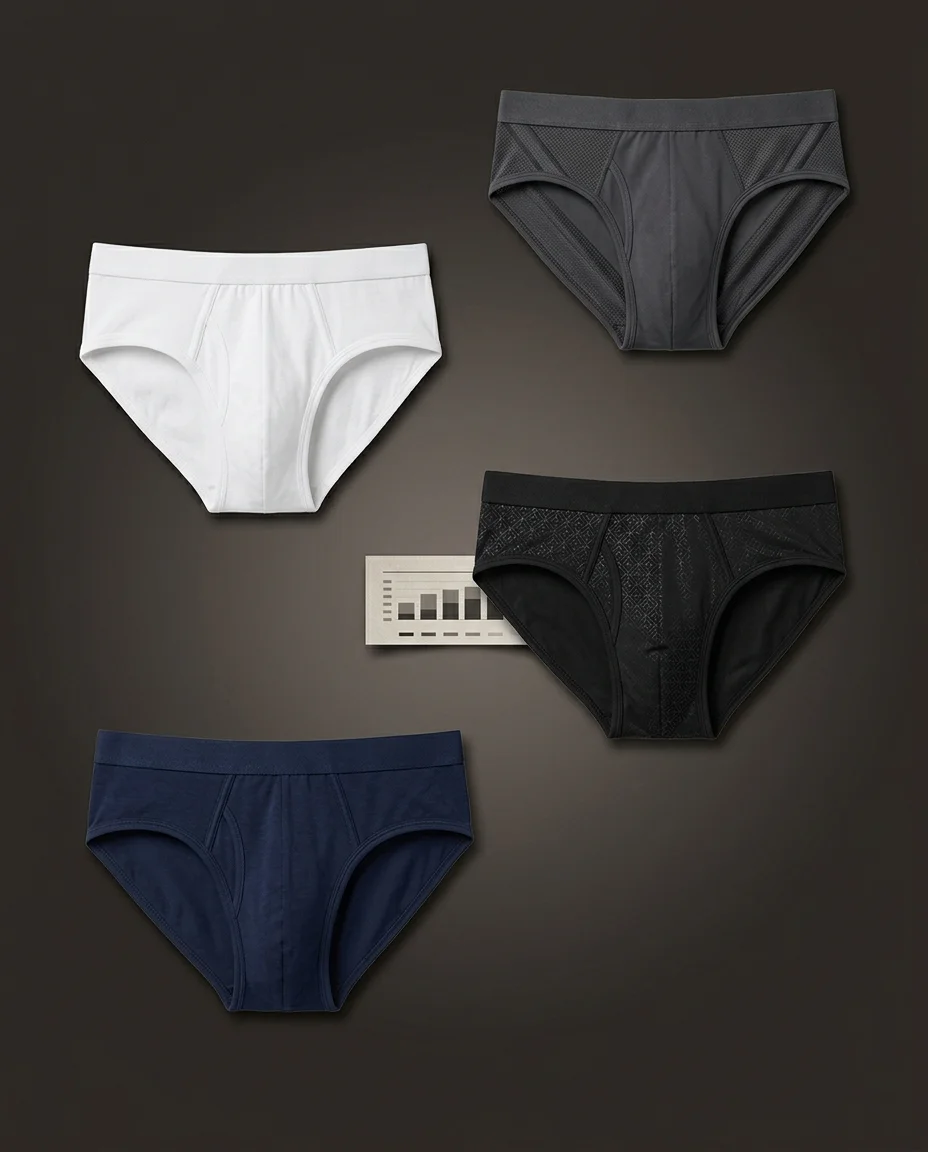
The men's briefs market is fragmenting from a single 'basics' category into four distinct competitive tracks. Traditional searches dropped 20-30%, while heated underwear (+2150%), seamless men's (+300%), and cooling fabrics (+180%) surge. This analysis breaks down four competitive tracks: budget basics, functional tech, premium fabrics, and performance sport — with pricing, technology requirements, and entry strategy for each.
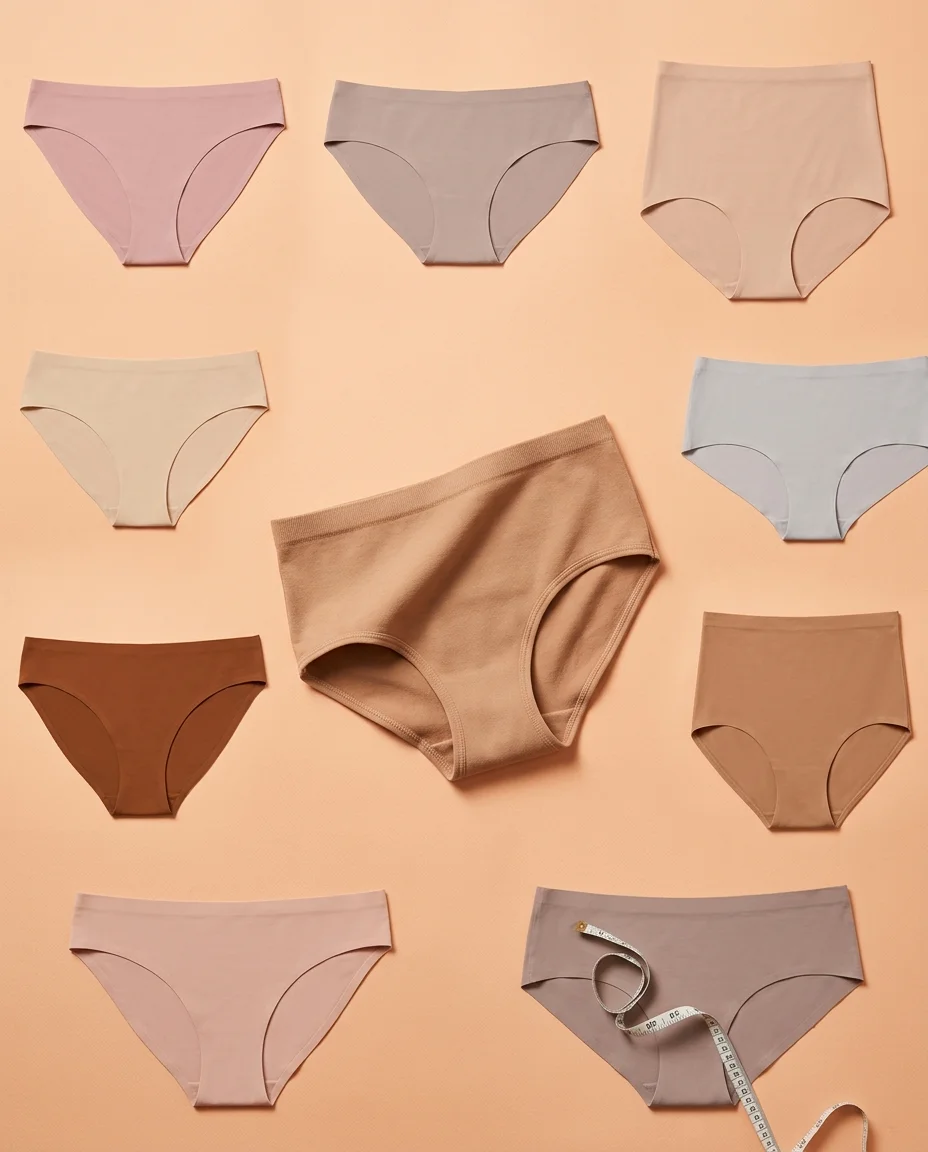
We tested 30+ seamless underwear brands across fabric recovery, waistband tension, and gusset construction. The results: only 6 brands use true circular knitting — most 'seamless' products are simply flat-lock seamed with marketing spin. This guide ranks the best seamless underwear by real performance data, not claims.
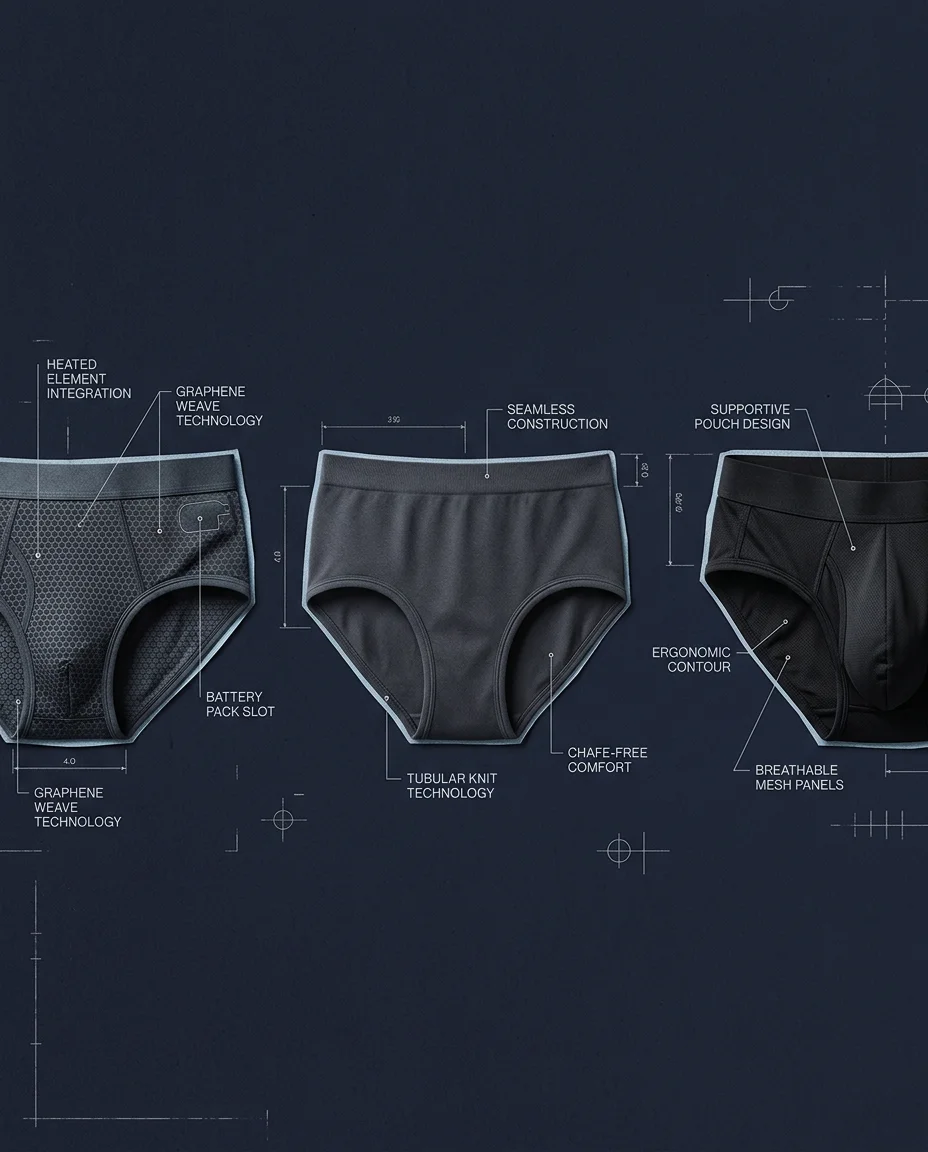
"Men's seamless underwear" search volume grew +300%, "heated underwear" +2150%, and "ball hammock underwear" +300% — men's underwear is fracturing from "basics" into functionally segmented categories. Meanwhile, generic "men's underwear" search volume declined -20-30%, indicating consumers no longer ask "what underwear to buy" but "what FUNCTION of underwear." We deconstruct the technical logic and selection criteria across four functional tracks: heating technology (graphene/far-infrared), seamless construction, pouch support systems, and moisture-wicking.