Product Design2026-04-0613 min read
Men's Functional Underwear Guide: Heated Warmth, Seamless Fit & Sports Support — A Technical Deconstruction
Paul PengFactory Technology Director
Part of the Manufacturing Solutions series
Part of the Manufacturing Solutions series
Q1 2026 search data sent a clear signal: male consumers are no longer asking "what underwear to buy" — they're asking "what FUNCTION of underwear."
Key insight: Generic "men's underwear" searches are down 20-30%, while every functional segment is growing rapidly. This means male consumers have completed a cognitive upgrade from "buying underwear" to "buying functional underwear" — brands still making "universal" styles will become increasingly difficult to find in search.
For the structural shift in men's underwear from briefs to boxer briefs, see our Men's Underwear Market Shift Data Report. This article focuses on deconstruction at the functional technology level.
"Heated underwear" search volume grew 2150% — this number requires sober interpretation. It includes significant seasonal factors (the harsh 2025-2026 winter driving searches), but the technological evolution of heated underwear itself is genuinely noteworthy.
Active Heating — Graphene/Carbon Nanotube Solution
Embeds graphene heating films or carbon nanotube conductive layers into the fabric, powered by a 5V low-voltage lithium battery. When activated, graphene converts electrical energy to heat within 30-40 seconds, with adjustable temperatures between 35-60°C (typically 3-level temperature control).
Technical advantages: Rapid heating, adjustable temperature, large coverage area (premium products can have 18 heating zones).
Technical bottlenecks: Battery life (3-10 hours), wash durability (most products are machine-washable but heating film lifespan is approximately 50-100 washes), wearing weight (battery + wiring adds approximately 150-300g).
Passive Thermal — Far-Infrared Ceramic Particle Solution
Far-infrared ceramic microparticles (zirconia, zirconium carbide, tourmaline, etc.) are mixed into fibers during spinning. The fabric absorbs body heat and re-radiates it back to the skin in the 4-14μm far-infrared band.
Technical advantages: No battery required, no additional weight, permanent functionality (no degradation from washing), low cost.
Technical limitations: Limited warming effect (approximately 1-3°C), driven by body temperature differential, cannot be actively adjusted.
Hybrid Solution — Graphene Fabric (Non-Electric Heating)
Graphene nanoplatelets are mixed into fibers or applied as coating, leveraging graphene's thermal conductivity (approximately 5000 W/mK) to accelerate even heat distribution across the fabric. Graphene also has far-infrared radiation properties. This solution uses no battery but offers higher thermal conductivity efficiency than traditional far-infrared ceramics.
Technical positioning: An "enhanced passive" solution between active and passive.
Far Infrared (FIR) wavelengths of 4-14μm are known as the "light of life" and can resonate with water molecules in human cells. Research shows that far-infrared radiation can promote local blood circulation and accelerate metabolism. A 2025 peer-reviewed study published on PMC confirmed that graphene-based far-infrared compression garments significantly improved aerobic exercise endurance — but note that this is primarily based on sports medicine scenarios; the far-infrared effect of everyday thermal underwear is far below medical-grade products.
For consumers:
For brands:
"Men's seamless underwear" grew +300% — male consumers are catching up to the seamless transition that women's underwear markets completed long ago.
For a complete technical breakdown of seamless underwear (Santoni circular knitting process, edge finishing technology, waistband solutions), see our Seamless Underwear Technology Guide. This section focuses on men-specific considerations.
In blind testing across 34 brands, 10 testers found that seamless underwear under high-frequency wear (4+ times per week) had an average effective lifespan of 3-5 months — significantly shorter than the 8-12 months for high-quality seamed underwear. The primary reason: circular-knit fabrics experience accelerated elastic fatigue under high stretch rates, and edges are prone to pilling after friction. Brands should consider noting "recommended usage period" in product descriptions to manage consumer expectations.
Conclusion: Seamless is not a universal solution. The true value of men's seamless underwear lies in the two scenarios of "sports" and "tight outer pants." If a consumer prioritizes "long-term comfort" over "absolute invisibility," high-quality seamed underwear (4-needle 6-thread construction + Modal fabric) may deliver a better overall experience.
"Ball hammock underwear" grew +300% — this once-niche keyword is going mainstream. Behind it is a new demand from male athletes for underwear functionality.
Flat Crotch Panel (Basic)
Traditional one-piece crotch design with no independent space. Suitable for daily low-activity wear. Cannot provide effective support during vigorous exercise; high inner-thigh friction risk.
Cost: Lowest. Target users: Daily wearers.
U-Shaped Contoured Crotch (Improved)
Three-dimensional tailoring adds curvature to the front crotch area, providing some spatial feel. But there is no left-right separation, so friction still occurs during high activity. Most mid-range brands use this approach.
Cost: Approximately $0.10-0.15/piece more than flat crotch. Target users: Moderate activity needs.
Independent Pouch / Separated Design (Functional)
Places the penis and testicles in separate spaces, minimizing inter-organ and inner-thigh friction. 3D pre-forming process allows the pouch to automatically conform to body shape.
Cost: Approximately $0.25-0.40/piece more than flat crotch. Target users: Sports, gym, extended walking/standing.
Testicular temperature needs to be 2-3°C below body temperature to maintain normal sperm vitality. Independent pouch design helps with local heat dissipation during sports by reducing fabric contact area and increasing airflow. This is not a medical claim but a natural result of thermodynamic principles — reduced contact area = reduced heat accumulation.
The 34-brand blind test revealed a core finding: the primary source of post-exercise dampness is not "whether there's a pouch" or "whether it's seamless," but choosing the wrong crotch fabric.
Dual-layer engineered fabric is the premium solution for sports underwear — the inner 100% Modal layer acts like a pump absorbing moisture, while the outer nylon + spandex layer acts like a drain conducting it away. This "absorb-conduct" separation engineering solves the contradiction of single-layer fabrics that either "absorb but can't release" or "release but can't absorb." Cost is approximately 3x that of regular single-layer fabric, but the experience difference in sports scenarios is decisive.
For complete fiber parameter comparison between Modal and Lyocell, see our Modal vs Lyocell Fabric In-Depth Comparison.
The 2026 men's underwear market is undergoing a functional分化:
If your brand is planning a men's functional underwear product line, the key is to select feature combinations based on target users' specific use cases — rather than stacking all features. An "all-in-one" combining "heating + seamless + pouch + moisture-wicking" is unrealistic under current technology; precise scenario matching is what creates genuinely differentiated products.
If you're looking for a manufacturing partner capable of dual-layer engineered fabrics, high-weight seamless construction, or independent pouch designs, explore XiaoTex's functional underwear R&D capabilities — their R&D center has full-range production capacity from 50s to 100s Modal, plus production experience in dual-layer structures and 3D pouch forming.
Data sources: This article references Google Trends 2026 Q1 search trend data, consumer blind-test data from 10 independent testers evaluating 34 brands over 103 days, peer-reviewed research on graphene far-infrared textile technology (PMC 2025), global cellulose fiber market reports (2025-2026), and sports textile engineering fabric moisture management performance testing data.
Business insights for apparel brand owners, from production strategies to manufacturing optimization
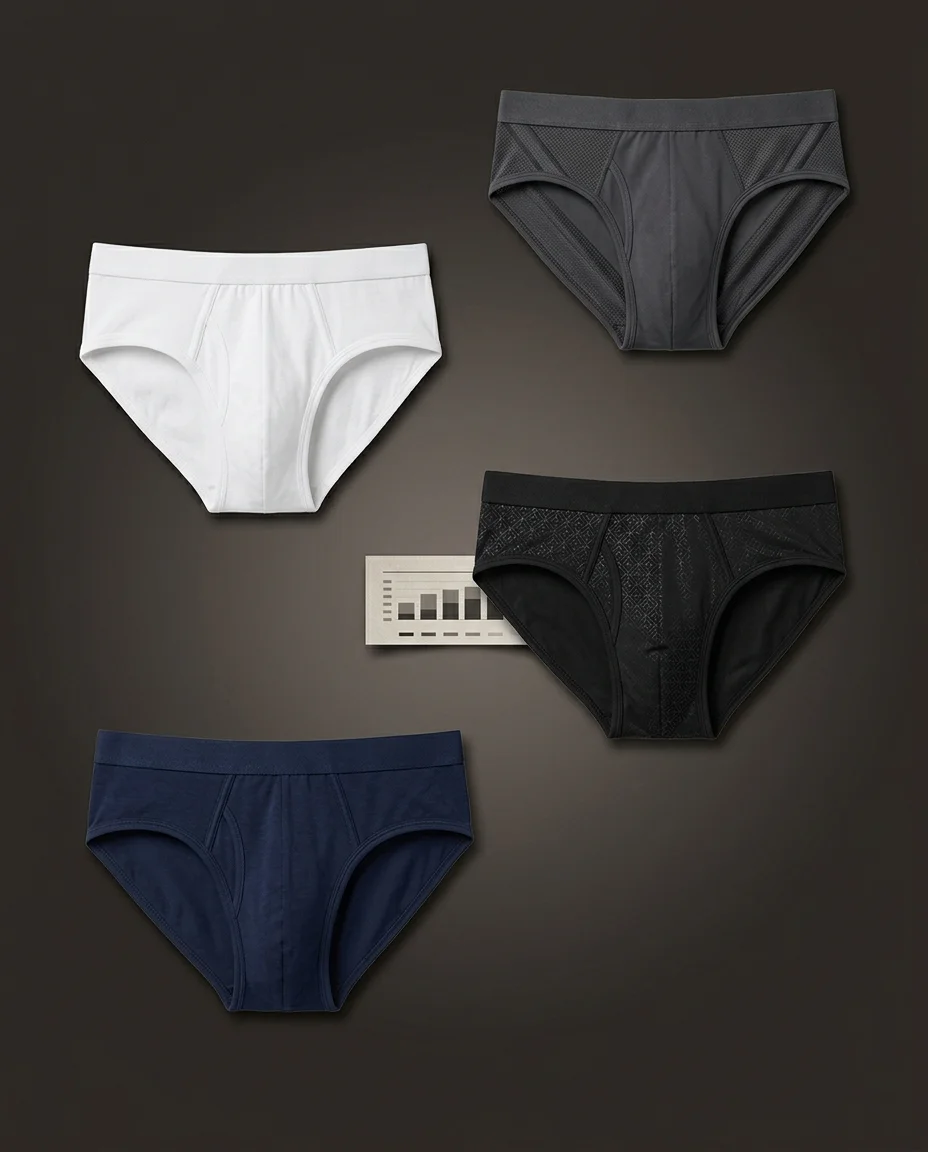
The men's briefs market is fragmenting from a single 'basics' category into four distinct competitive tracks. Traditional searches dropped 20-30%, while heated underwear (+2150%), seamless men's (+300%), and cooling fabrics (+180%) surge. This analysis breaks down four competitive tracks: budget basics, functional tech, premium fabrics, and performance sport — with pricing, technology requirements, and entry strategy for each.
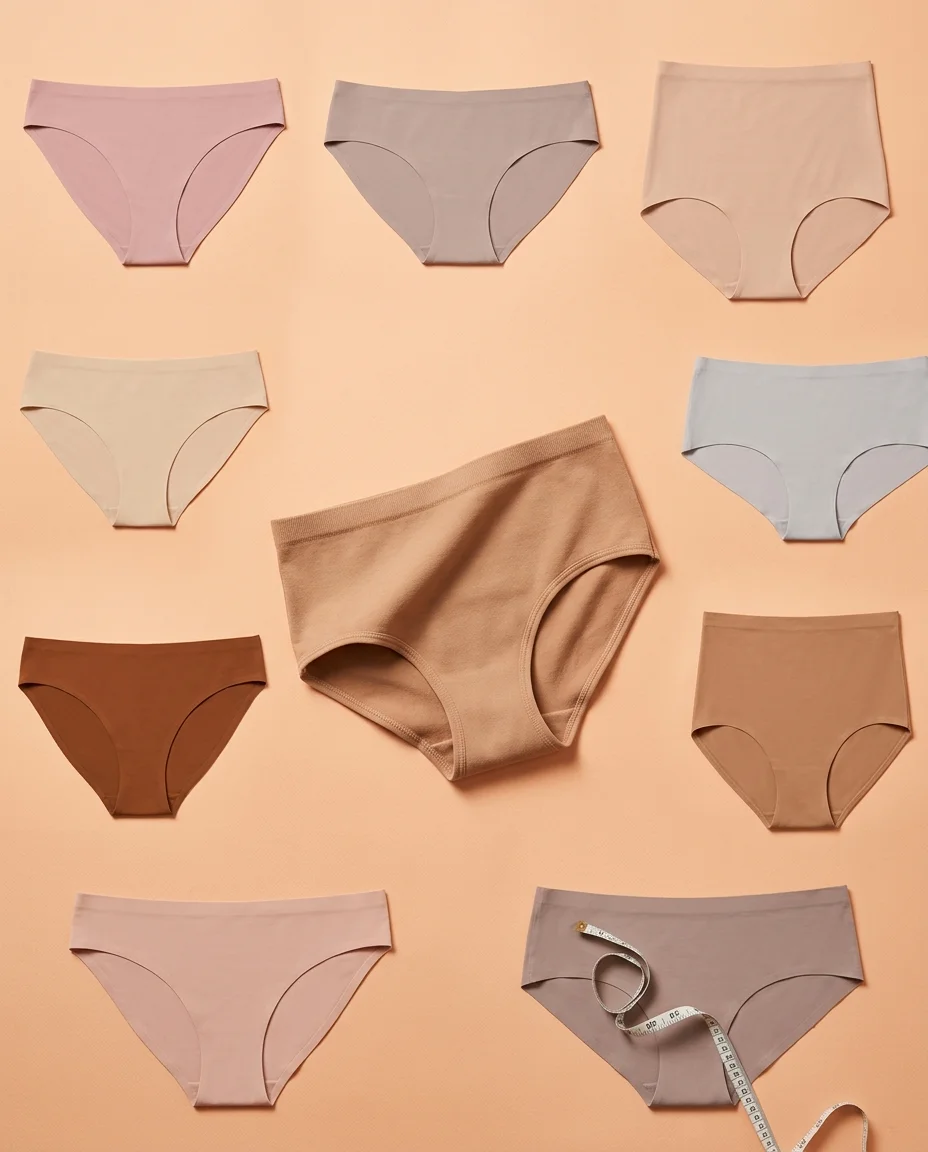
We tested 30+ seamless underwear brands across fabric recovery, waistband tension, and gusset construction. The results: only 6 brands use true circular knitting — most 'seamless' products are simply flat-lock seamed with marketing spin. This guide ranks the best seamless underwear by real performance data, not claims.
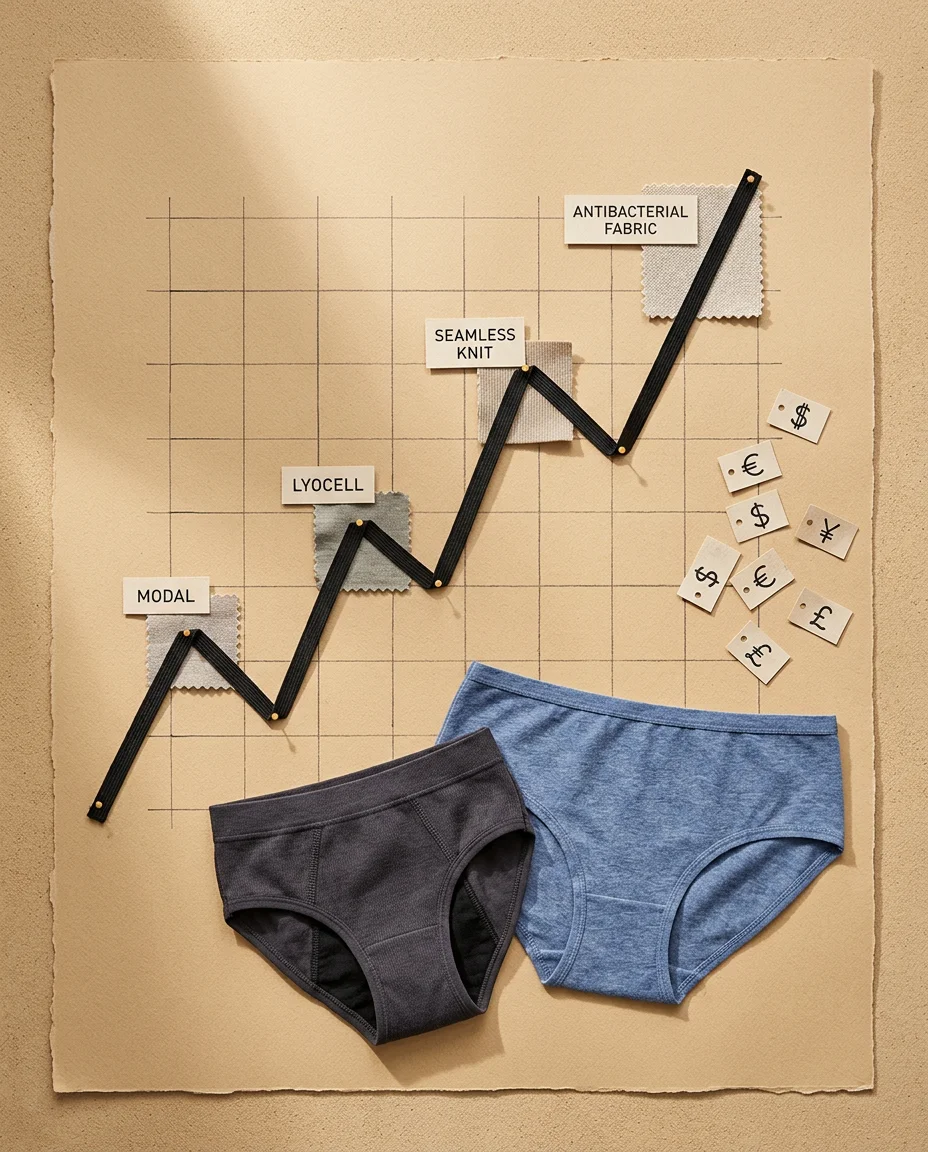
The underwear market is projected to reach $127.4B by 2032. We analyze 2026's trending products — period underwear (+300%), seamless (+110%), plus-size (+130%), and antibacterial Modal — with market data, fabric innovation timelines, and regional growth forecasts for brand planning.