Fabric Science2026-03-089 min read

The Elasticity Equation: Balancing Stretch, Cost, and Durability in Your Underwear Line

Karl XiaoFactory Production Director

Part of the The Fiber Lab series

10 min read

The Elasticity Equation: Balancing Stretch, Cost, and Durability in Your Underwear Line#

Why "Bagging" is Killing Your Customer Retention#

Customers don't return underwear because it's too stretchy—they return it because it loses shape. After 10 washes, 100% cotton underwear sags, bags, and loses the fit that made customers buy it in the first place.

As a brand owner, you need to understand that 5% spandex is the magic number that balances stretch, recovery, and cost. Too little spandex and your product bags out. Too much and you're wasting money on unnecessary elasticity.

For DTC underwear brands, shape consistency is directly linked to customer loyalty. Here's how to optimize spandex content for your price point while maintaining fit across sizes and washes.


Quick Science Recap (For Context)#

For a deep dive into the science, read our original guide: The Elasticity Equation: Why 5% Spandex is the Magic Number

The key principles:

  • 100% cotton underwear loses shape after 5-10 washes due to fiber relaxation
  • Spandex (elastane) provides recovery—the ability to return to original shape
  • 5% spandex is optimal for most underwear applications (enough stretch + recovery)
  • Higher spandex ≠ better: 10-15% spandex costs more but doesn't improve performance for most styles

The Manufacturing Perspective: Spandex Sourcing & Cost#

When sourcing elastic fabrics, you're balancing three factors: performance, cost, and durability. Understanding spandex sourcing helps you make informed decisions.

Spandex Content by Price Point#

Best for: Budget lines, disposable underwear, loungewear Cost: $2-3/kg fabric Stretch: Minimal (20-30% mechanical stretch from knit structure) Recovery: Poor—bags out after 5-10 washes Customer Satisfaction: Low—high return rates

Best for: Standard underwear, mid-tier to premium lines Cost: $3-4/kg fabric Stretch: 100-150% with excellent recovery Recovery: Excellent—maintains shape after 50+ washes Customer Satisfaction: High—industry standard

Best for: Shapewear, compression underwear, athletic styles Cost: $4-5/kg fabric Stretch: 150-200% with superior recovery Recovery: Excellent—but unnecessary for most underwear Customer Satisfaction: Diminishing returns—higher cost, same perception

Cost-Benefit Analysis#

The lesson: 5% spandex offers the best ROI. Moving from 0% to 5% spandex costs $0.15 per garment but saves $26,100 in returns and customer churn. Moving to 10% adds $0.20 more with minimal performance gain.


Business Impact: Fit Consistency Across Sizes#

One of the biggest challenges for underwear brands is maintaining consistent fit from XS to 4XL. Spandex content and quality control are critical to solving this problem.

The Size-Inclusive Fit Challenge#

The Fit Consistency Problem:

When a customer buys a Medium and loves the fit, then buys a Large and it feels completely different—you've lost a customer. Fit inconsistency across sizes is a primary driver of brand abandonment.

Common issues:

  • Smaller sizes (XS-S): Too tight, digs into skin
  • Larger sizes (3XL-4XL): Too loose, bags out, no support
  • Same size label: Different fit between production runs
  • Result: Customers order once, don't return

Manufacturing Solution: Tension Grading#

Professional factories use tension grading to ensure consistent fit across sizes:

  1. Base Size Development: Create perfect fit in size M (6 spandex, specific knit structure, tension settings)
  2. Tension Mapping: Measure stretch percentage and recovery force for base size
  3. Size Grading: Adjust pattern dimensions AND tension settings for each size
  4. Fit Testing: Real human models test fit in each size (not just measurements)
  5. QC Standardization: Document tension settings for each size to ensure consistency

Factory Capability Question: "Do you use tension grading or just measurement grading?" Tension grading costs 15-20% more but prevents size-fit inconsistency.


Specification Guidelines: What to Put in Your Tech Pack#

When creating your tech pack for elastic underwear, include these specifications:

Essential Elasticity Specs#

Tech Pack Requirements:

Fabric Composition:

  • Standard: 95% cotton / 5% spandex (minimum for shape retention)
  • Premium: 90% cotton / 10% spandex (for athletic/shapewear styles)
  • Budget: 100% cotton (accept higher return rate)

Performance Standards:

  • Stretch: 100-150% elongation (5% spandex) or 150-200% (10% spandex)
  • Recovery: 90% or higher after 5-minute stretch test
  • Growth: Maximum 5% after 30-minute wear simulation
  • Durability: Maintain properties after 50 wash cycles (ISO 105-C06)

Testing Requirements:

  • Pre-production: Stretch and recovery testing (ASTM D2594 standard)
  • In-line QC: Verify spandex percentage and fabric weight
  • Final inspection: Stretch test every 50th piece

Size-Specific Tension:

  • Document required tension force for each size (XS-4XL)
  • Specify allowable variation (+/- 10%)

Red Flags: What Indicates Poor Elastic Quality#

When evaluating samples or factory capabilities, watch for:

Warning Signs of Elastic Quality Issues:

  1. "White Spandex" Visible: Spandex fibers visible on fabric surface = poor quality knitting
  2. Inconsistent Stretch: Some areas stretch more than others = uneven spandex distribution
  3. No Recovery Data: Factory can't provide stretch/recovery test reports
  4. Cheap Price: Suspiciously low "spandex" fabric price = likely lower spandex percentage or poor quality
  5. Bagging After First Wash: Sample loses shape immediately = poor recovery quality
  6. No Tension Grading: Factory grades only by measurements, not tension

Manufacturing Process: From Tech Pack to Production#

Understanding how factories handle elastic fabrics helps you avoid shape consistency disasters.

Step 1: Fabric Sourcing & Verification#

Timeline: 1-2 weeks

  • Factory sources cotton/spandex blend from certified suppliers
  • Critical: Request lab test for spandex percentage (many factories under-report spandex to save cost)
  • Factory sends swatches for your approval
  • You verify: Stretch percentage, recovery speed, hand-feel
Factory Insider Tip:

Always request a burn test or lab analysis to verify spandex percentage. Spandex melts and smells like burning rubber when ignited—cotton turns to ash. Many "5% spandex" fabrics are actually 2-3% spandex, causing bagging issues after 20 washes.

Step 2: Tension Testing & QC Standard Development#

Timeline: 1 week

  • Factory tests fabric stretch and recovery properties
  • Creates tension standards for each size (XS-4XL)
  • Documents knitting machine settings for each size
  • You approve: Tension standards before production begins

Step 3: PP Sample (Pre-Production Sample)#

Timeline: 1 week

  • Factory creates samples in multiple sizes (S, M, L, XL at minimum)
  • You test: Fit consistency across sizes, stretch comfort, recovery after 30-minute wear
  • Critical test: Wear sample for 30 minutes, check for bagging or digging
  • Approve or request adjustments

Step 4: Bulk Production & Tension QC#

Timeline: 2-4 weeks (depending on quantity)

  • Factory cuts and sews garments using size-specific tension settings
  • In-line QC: Verify tension settings every 50 pieces, check for spandex exposure
  • Final QC: Stretch test 10% of finished goods, verify fit consistency
  • Factory ships finished goods

Industry Terminology: What to Say When#

When communicating with factories about elasticity, use these industry terms:

Key Terminology:

  • Elongation: How much a fabric stretches from its original length. 100% elongation = doubles in length.
  • Recovery: Ability of fabric to return to original length after stretching. 90% recovery = returns to 90% of original length.
  • Growth: Permanent elongation after extended wear. Low growth = better shape retention.
  • Tension Grading: Adjusting both pattern dimensions AND tension settings for each size to ensure consistent fit.
  • Power Net: High-compression fabric with high spandex content (15-30%) for shapewear.
  • ASTM D2594: American standard for testing stretch properties of fabrics.
  • White Spandex: Visible spandex fibers on fabric surface—indicates poor quality knitting or low-quality yarn.

Quality Control: Testing Elastic Performance#

Don't assume elastic fabric performs as promised. Verify with these tests:

Pre-Production Testing (Before You Commit)#

  1. Stretch Test:

    • Mark 10cm on fabric
    • Stretch to maximum (without damaging)
    • Measure stretched length
    • Pass: 100-150% elongation for 5% spandex
  2. Recovery Test:

    • Stretch fabric to 100% elongation
    • Hold for 30 seconds
    • Release and measure after 1 minute
    • Pass: Returns to within 10% of original length (90% recovery)
  3. Bagging Test:

    • Cut sample, simulate 30-minute wear (stretch and hold)
    • Measure any permanent elongation
    • Pass: Less than 5% growth

Production QC Testing (During Manufacturing)#

  • Every 50th piece: Stretch test and visual inspection for white spandex
  • Every size: Verify fit consistency (don't just test one size)
  • Every batch: Lab test for spandex percentage verification

Sourcing Decision Framework#

Use this framework when deciding on spandex content for your line:

Decision Matrix:

Budget Line ($8-12 retail):

  • Use: 95% cotton / 3-5% spandex OR 100% cotton (accept higher returns)
  • Target: Price-conscious customers who prioritize low cost over longevity
  • Market: "Affordable basics"
  • Expect: 10-12% return rate for fit issues

Mid-Tier Line ($15-25 retail):

  • Use: 95% cotton / 5% spandex (industry standard)
  • Target: Balance of performance and cost
  • Market: "Everyday comfort that lasts"
  • Expect: 3-5% return rate for fit issues

Premium Line ($30+ retail):

  • Use: 90% cotton / 10% spandex OR specialty elastic (for athletic features)
  • Target: Maximum performance and longevity
  • Market: "Premium fit, athletic-grade performance"
  • Expect: 2-3% return rate for fit issues

Common Mistakes Brand Owners Make#

Mistake 1: Assuming More Spandex = Better Fit#

Reality: 10% spandex costs 40% more than 5% spandex but provides minimal perceived benefit for standard underwear.

Solution: Use 5% spandex for standard styles, reserve 10%+ for athletic/shapewear lines.

Mistake 2: Not Verifying Spandex Percentage#

Reality: Many factories claim "5% spandex" but actually use 2-3% to save money.

Solution: Request lab analysis, perform burn test, verify with stretch testing.

Mistake 3: Ignoring Fit Consistency Across Sizes#

Reality: A Medium that fits perfectly and a Large that feels different loses customers forever.

Solution: Require tension grading, test multiple sizes in PP sample, document size-specific QC standards.

Mistake 4: Focusing Only on Cost#

Reality: Saving $0.15 per garment on fabric costs you $26,100 in returns and lost CLV per 1000 units.

Solution: Calculate total cost impact including returns, customer churn, and brand reputation—not just per-unit fabric cost.


The Bottom Line: Spandex is Your ROI Driver#

For DTC underwear brands, spandex content isn't just a technical detail—it's a retention driver and profit lever.

When you get it right:

  • Lower return rates (3% vs 12% for 100% cotton)
  • Higher customer lifetime value ($78 vs $45)
  • Increased repeat purchases (45% vs 22%)
  • Reduced negative reviews about "bagging"

When you get it wrong:

  • Negative reviews about poor fit and shape retention
  • Customers switching to competitors
  • Higher return processing costs
  • Brand reputation damage

The math is clear: 5% spandex costs $0.15 more per garment than 100% cotton but generates $26,100 more value per 1000 units through reduced returns and higher CLV.


Ready to Optimize Your Elasticity Strategy?#

Don't let poor fit consistency kill your brand's growth. Whether you're launching a new line or fixing fit issues in an existing one, understanding spandex content and manufacturing quality control is critical to reducing returns and building customer loyalty.

Get Expert Guidance:

  • Fit Consistency Guide: Learn tension grading and size-inclusive design best practices
  • Factory Matching: We connect you with manufacturers verified for elastic fabric expertise
  • Tech Pack Review: We'll review your specs and identify elasticity optimization opportunities

Contact Us to Get Your Fit Consistency Guide


Sources: This B2B guide is based on textile engineering research (ASTM D2594 stretch testing standards), spandex fiber technical specifications from leading elastane producers, industry return rate analysis from DTC underwear brands, and manufacturing cost analysis from China supply chain partners.

About this series

Deep dive into fabric composition, properties, and performance at the microscopic level
Related Articles

Is Your Underwear Causing Skin Problems? The Fabric-Skin Health Connection
Fabric Science13 min read

Is Your Underwear Causing Skin Problems? The Fabric-Skin Health Connection

That recurring rash below your waistline. The itch that will not go away. The red marks where your underwear elastic sits. "Underwear rash" and "underwear irritation" searches have grown steadily as consumers discover their underwear may be the hidden cause of skin problems. We analyzed the four fabric-skin interaction mechanisms — bacterial microclimate, chemical contact dermatitis, pressure dermatitis, and antibacterial treatment sensitivity — with test data across 30+ brands.
Karl XiaoFactory Production Director
·2026-04-12
Why Does My Underwear Ride Up, Roll Down & Bunch? The Fit Science Fix
Fabric Science12 min read

Why Does My Underwear Ride Up, Roll Down & Bunch? The Fit Science Fix

You adjust your underwear five times before lunch. The waistband rolls, the legs ride up, and everything bunches in the wrong places. "Why does my underwear keep riding up" is one of the most searched underwear complaints globally. We break down the four scientific causes — elastic recovery degradation, rise-torso mismatch, leg opening geometry, and fabric stretch ratio — and provide body-type-specific solutions based on testing across 30+ brands.
Karl XiaoFactory Production Director
·2026-04-12
5 Underwear Marketing Terms That Lie to You — And the Fiber Science Behind Each One
Industry Trends14 min read

5 Underwear Marketing Terms That Lie to You — And the Fiber Science Behind Each One

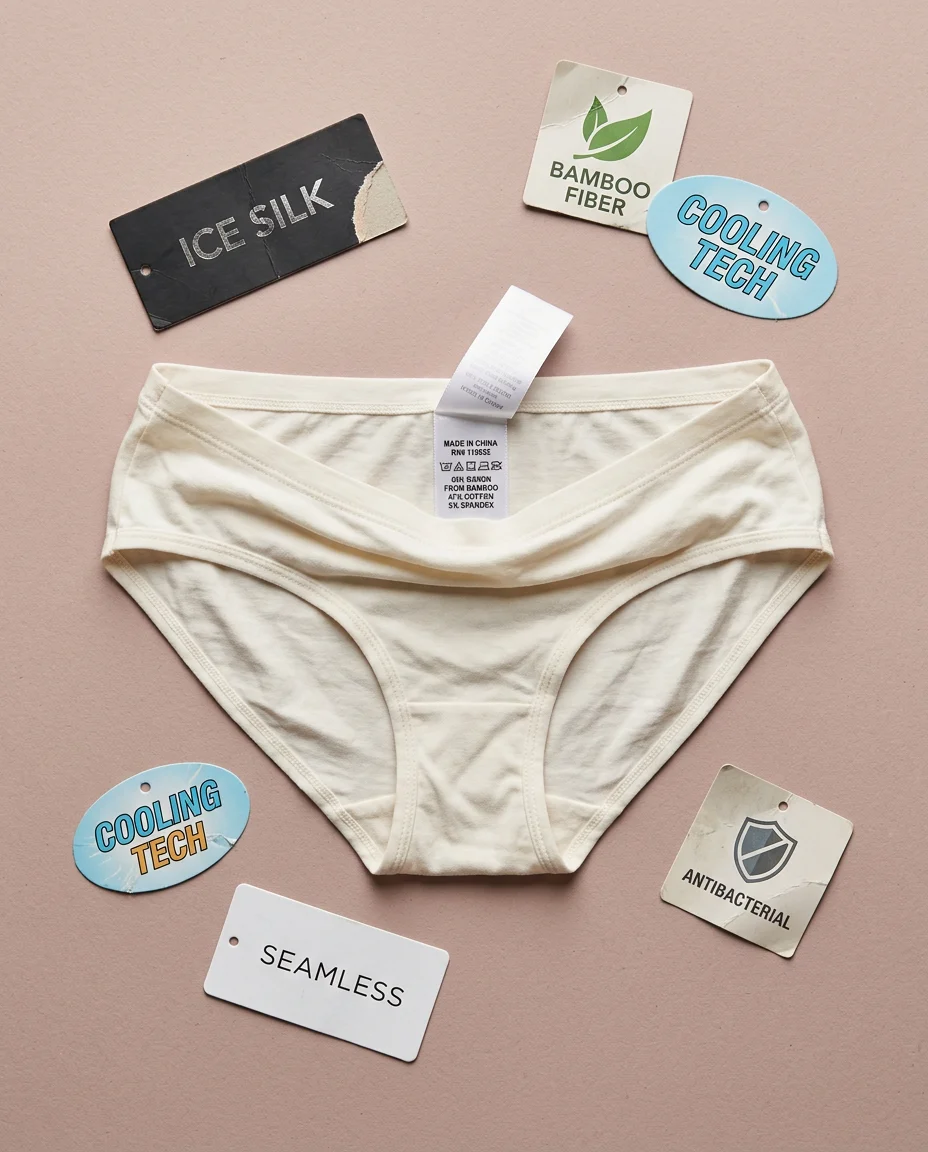
Your underwear label says "ice silk," "bamboo fiber," "seamless," "cooling technology," and "antibacterial." Three of those five terms do not mean what you think they mean. We deconstructed each marketing claim against published fiber science data and found a consistent pattern: the most expensive-sounding terms describe the cheapest materials.

Karl XiaoFactory Production Director
·2026-04-11

Contact Us

Scale Your Brand with Flexible Manufacturing

Let's discuss how our capabilities can help you build your brand.