Fabric Science2026-04-1212 min read
Why Does My Underwear Ride Up, Roll Down & Bunch? The Fit Science Fix
Karl XiaoFactory Production Director
Part of the The Fiber Lab series
Part of the The Fiber Lab series
You adjusted your underwear five times before noon today. The waistband curls inward. The legs climb up your thighs. And the seat area collects enough excess fabric to origami-fold a crane.
Physical discomfort queries growing faster than product searches
These are not minor annoyances. In blind evaluations across 30+ brands, fit discomfort — not color, not style, not even price — was the single most common reason consumers rejected a product. And yet, most "solutions" articles simply recommend buying a different brand, without ever explaining why the problem occurs.
We are going to fix that. This article breaks down the four scientific mechanisms behind underwear ride-up, roll-down, and bunching — and gives you body-type-specific solutions based on fabric testing data.
Every underwear waistband and leg opening contains spandex (elastane) fibers blended with the primary fabric. When new, these fibers stretch and snap back with close to 100% recovery. But spandex degrades over time — and the degradation curve is steeper than most consumers realize.
The percentage of original length a stretched fabric returns to after being released. A recovery rate of 90%+ means the garment maintains its shape well. Below 70%, the garment begins to sag, ride up, or bunch because the fabric can no longer grip the body with adequate tension.
What the testing data shows:
The data reveals a critical insight: 40-count Modal degrades faster than cotton in elastic recovery. Many consumers switch from cotton to modal expecting better performance, but if they choose a low yarn count, they experience worse ride-up within weeks.
Hot water washing (above 40°C / 104°F) accelerates spandex degradation by 2-3x compared to cold water. The majority of consumers wash underwear in warm or hot water for hygiene reasons — ironically destroying the elastic that keeps the garment in place. The result: a 30-wash degradation curve compressed into 10-12 washes.
Based on testing data, we observe a clear behavioral threshold:
The "rise" of underwear — the distance from the crotch seam to the top of the waistband — determines where the garment sits on your body. When the rise is too short for your torso length, the waistband has only one direction to go: down.
The physics: When you sit, bend, or move, your torso compresses vertically. A low-rise waistband on a long torso is pulled in two directions simultaneously — the crotch seam anchors it from below while body movement pushes it from above. With no fabric reserve to absorb this compression, the waistband rolls inward (the dreaded "curl") and slides down.
This is not a quality issue. Even premium underwear will roll down if the rise does not match your torso. The same garment that performs perfectly on a short-torso wearer will fail on a long-torso body.
Stand upright and measure from your navel to the top of your inner thigh (crotch crease). This measurement approximates the minimum rise you need. If your measurement is 22+ cm, low-rise underwear will almost certainly roll down regardless of brand or price.
Leg openings are the most commonly overlooked fit dimension. The problem occurs when the leg opening circumference does not match the wearer's thigh circumference:
Too wide (ride-up): When the leg opening is wider than the thigh, the fabric has nothing to anchor against. During walking, the fabric slides upward because there is no tension holding it in place. This is especially common with boxer-style underwear on slender thighs.
Too narrow (digging + chafing): When the leg opening is too tight, it creates pressure lines and restricts blood flow during prolonged sitting. The elastic also degrades faster because it is constantly stretched beyond its designed range.
Just right (stable fit): The leg opening should have 1-3 cm of gentle tension around the thigh. Not tight enough to leave marks, not loose enough to slide freely.
Some premium underwear brands now include a thin silicone strip inside the leg opening hem. This creates friction-based grip that prevents ride-up without increasing elastic tension. In testing, silicone-gripped underwear showed 80% less ride-up incidence compared to equivalent styles without silicone strips.
The stretch ratio of underwear fabric — how much it extends under tension — determines how well the garment maintains its shape during wear. Most consumers never consider this metric, but it is arguably the most important predictor of ride-up and bunching.
The pattern is clear: lighter-weight, higher-stretch fabrics ride up more. Thin 40-count modal has the highest stretch ratio (30-40%) and the poorest shape recovery after washing — a combination that guarantees ride-up and bunching as the garment ages.
Understanding your body type is essential for choosing underwear that stays in place. Here is the complete mapping:
Characteristics: Wider waist, narrower hips, shorter distance between waist and hip crease.
Common problems: Waistband roll-down, excess fabric at hips.
Best styles: High-rise briefs with wide (3+ cm) waistbands. The wide waistband distributes pressure evenly and the high rise provides enough length to prevent roll-down. Avoid low-rise cuts entirely.
Fabric recommendation: Interlock cotton or 80-count Modal with no more than 20% stretch ratio.
Characteristics: Narrower waist, wider hips, fuller thighs.
Common problems: Leg opening too tight (digging), waistband gapping at back.
Best styles: Hip-friendly cuts with deeper leg openings and a slightly higher rise. Look for "full coverage" or "hipster" styles. The waistband should sit at or just above the hip bone, where the body circumference is most stable.
Fabric recommendation: Stretch cotton blends or modal with good recovery. Avoid rigid fabrics that cannot accommodate hip-to-waist ratio differences.
Characteristics: Similar waist and hip measurements, relatively straight silhouette.
Common problems: Minimal — most standard styles fit reasonably well.
Best styles: Boxer briefs offer the most stable fit because they cover a large surface area with consistent tension. Trunks and briefs also work well.
Fabric recommendation: Any mid-weight fabric (150-180 gsm) with moderate stretch (20-25%).
Characteristics: Defined waist with proportionally wider hips and bust.
Common problems: Waistband either digs at the natural waist or gaps at the back. Leg openings may be tight relative to the waist fit.
Best styles: Mid-rise styles that sit at the hip bone rather than the natural waist. Look for "contour waistbands" that curve to follow the body shape rather than straight-cut elastic bands.
Fabric recommendation: Fabrics with 20-30% stretch to accommodate the waist-to-hip transition without gapping.
Measure your minimum rise: From navel to crotch crease. Your underwear rise should be at least this length.
Check the fabric weight: Look for 150+ gsm for daily wear. Anything below 140 gsm (especially 40-count modal) will stretch out and ride up.
Verify elastic recovery at the store: Stretch the waistband 2-3 inches and release. It should snap back instantly with no visible lag. If it returns slowly, the elastic is low quality.
Match the leg opening to your thigh: The leg opening should have gentle tension — you should feel it, but it should not leave a mark after 1 hour of wear.
Wash cold, always: 30°C maximum. Hot water destroys spandex recovery and converts a 30-wash garment into a 10-wash garment.
Fabric testing data: Independent blind-test evaluations across 30+ brands with multiple testers, supplemented by third-party laboratory elastic recovery and stretch ratio tests (AATCC standards).
Body type fit analysis: Compiled from consumer fit feedback across multiple market segments, cross-referenced with garment pattern engineering principles.
Search trend data: Google Trends analysis of underwear fit complaint queries, 2024-2026.
Related articles for deeper reading:
Deep dive into fabric composition, properties, and performance at the microscopic level
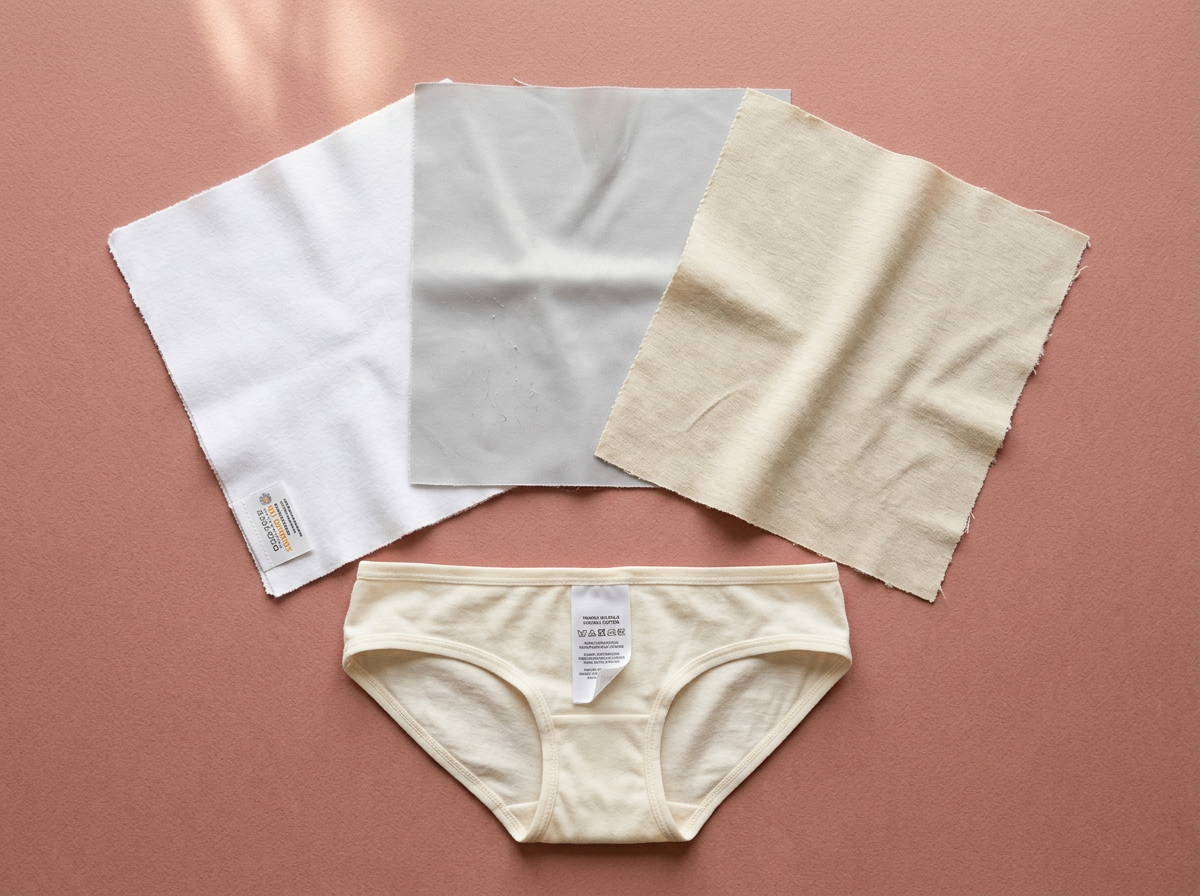
That recurring rash below your waistline. The itch that will not go away. The red marks where your underwear elastic sits. "Underwear rash" and "underwear irritation" searches have grown steadily as consumers discover their underwear may be the hidden cause of skin problems. We analyzed the four fabric-skin interaction mechanisms — bacterial microclimate, chemical contact dermatitis, pressure dermatitis, and antibacterial treatment sensitivity — with test data across 30+ brands.
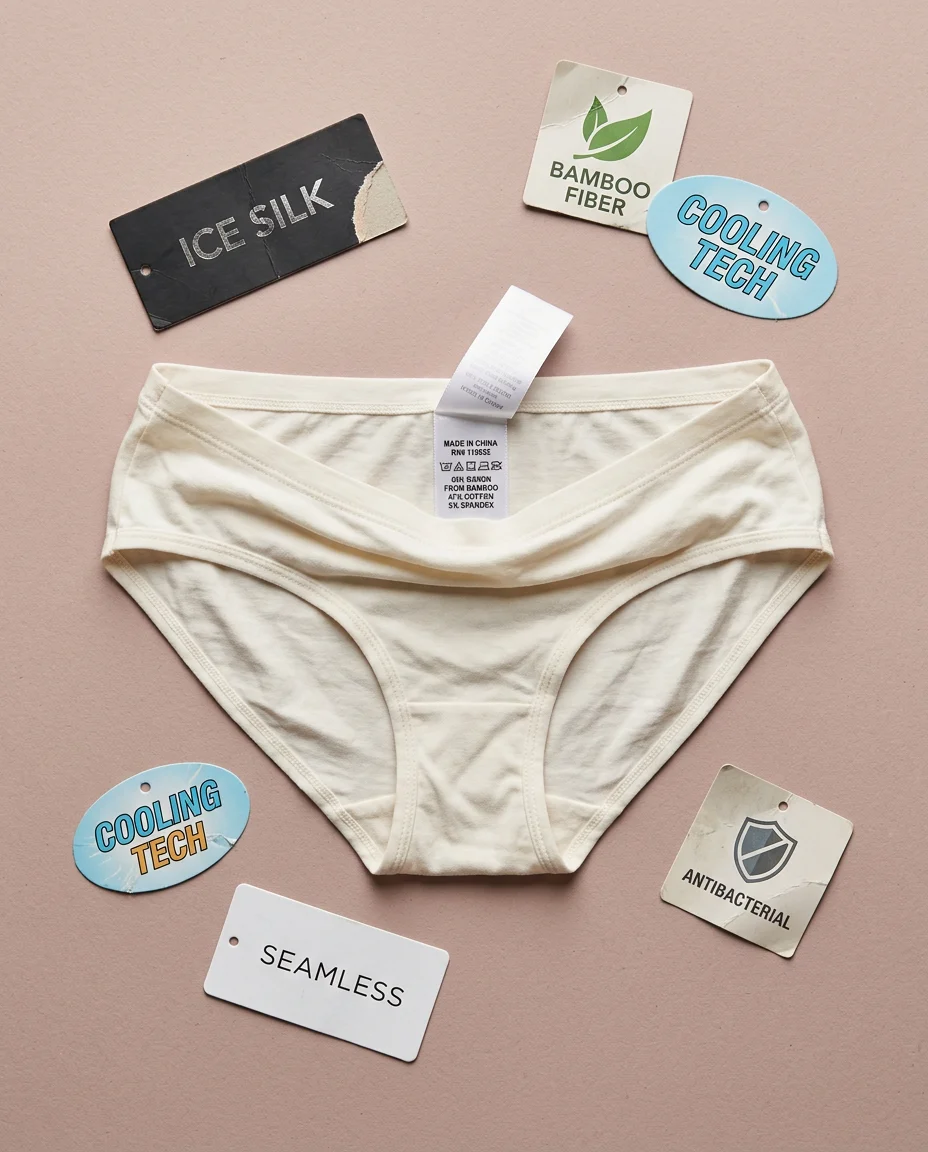
Your underwear label says "ice silk," "bamboo fiber," "seamless," "cooling technology," and "antibacterial." Three of those five terms do not mean what you think they mean. We deconstructed each marketing claim against published fiber science data and found a consistent pattern: the most expensive-sounding terms describe the cheapest materials.
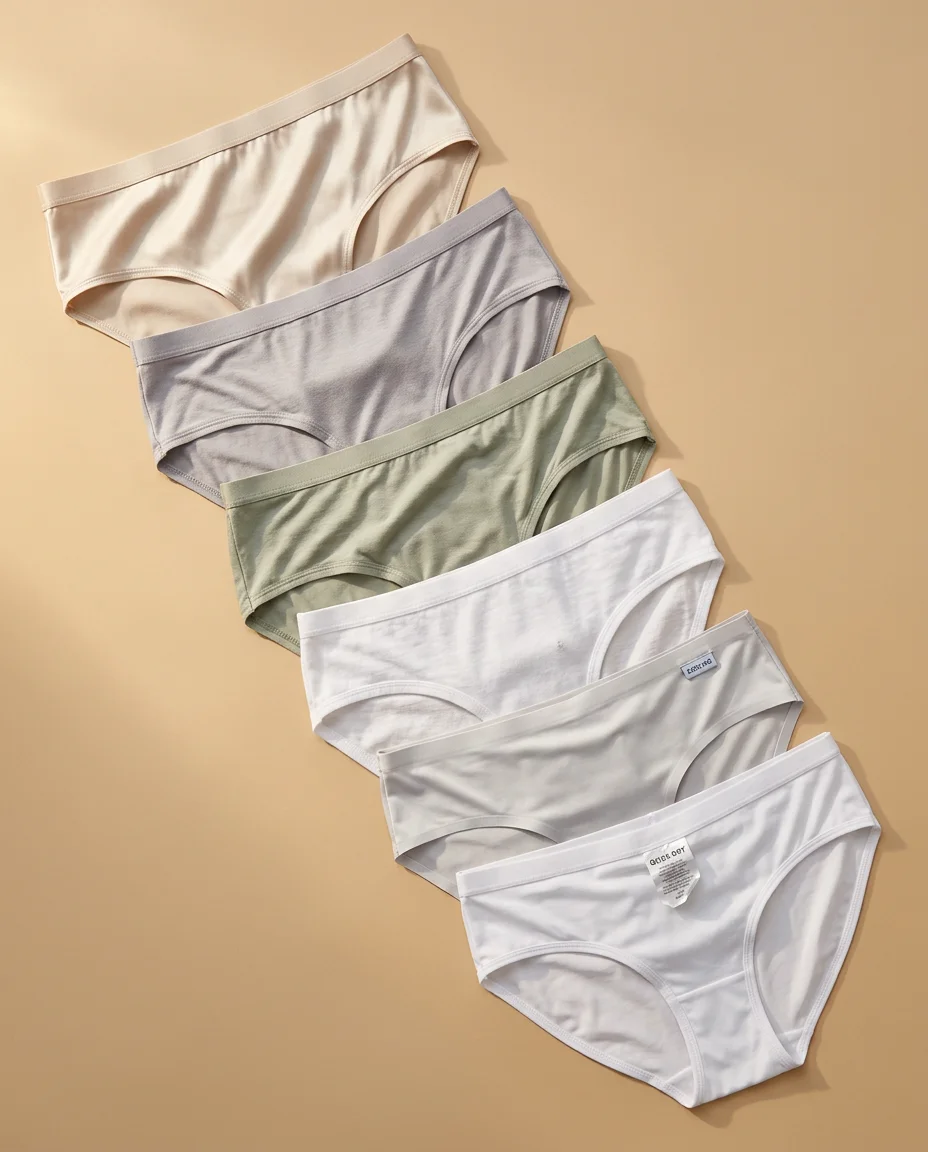
Six fabrics, one question: which one actually keeps you cool? We ranked common summer underwear materials by Q-max contact cooling, sustained heat dissipation, and moisture vapor transmission — and found that the three most heavily marketed fabrics are also the three worst performers after 30 minutes of wear.