Supply Chain Strategy2026-03-2412 min read
How to Start a Lingerie Line: First Sketch to First Sale
Paul PengFactory Technology Director
Part of the Manufacturing Solutions series
Part of the Manufacturing Solutions series
You have the vision. You've sketched the designs. You know exactly what your target customer wants. But when you reach out to manufacturers, you hit the same wall: "Minimum Order Quantity: 500 pieces per style."
For emerging lingerie brands, this is where dreams die.
Tying up thousands of dollars in inventory before you've made your first sale isn't just risky—it's often impossible. Add to that the 6-8 week sampling cycles, communication barriers with overseas factories, and quality concerns... it's no wonder so many passionate entrepreneurs give up before they begin.
But what if there was another way?
What if you could partner with a manufacturer who understands that great brands start small? Who offers flexible MOQs designed for testing rather than mass production? Who can deliver prototypes in 3-7 days instead of 3-7 weeks?
This guide will show you exactly how to start a lingerie line—and find a partner who helps you launch rather than block your path.
Loading video...
Before diving into the "how," it's important to understand why lingerie is uniquely challenging compared to other apparel categories:
Fit is Everything Unlike a t-shirt that can be slightly oversized and still wearable, lingerie must fit precisely. A bra that digs or panties that gap will destroy your brand reputation faster than any marketing can build it.
Intimate = Trust When customers buy lingerie, they're trusting you with something that goes against their skin. Quality, fabric choice, and construction aren't just details—they're your brand promise.
Small Details, Big Impact The difference between a 5-star review and a return often comes down to: seam placement, elastic softness, gusset construction, and fabric breathability.
This is why choosing the right manufacturing partner isn't just about production—it's about brand survival.
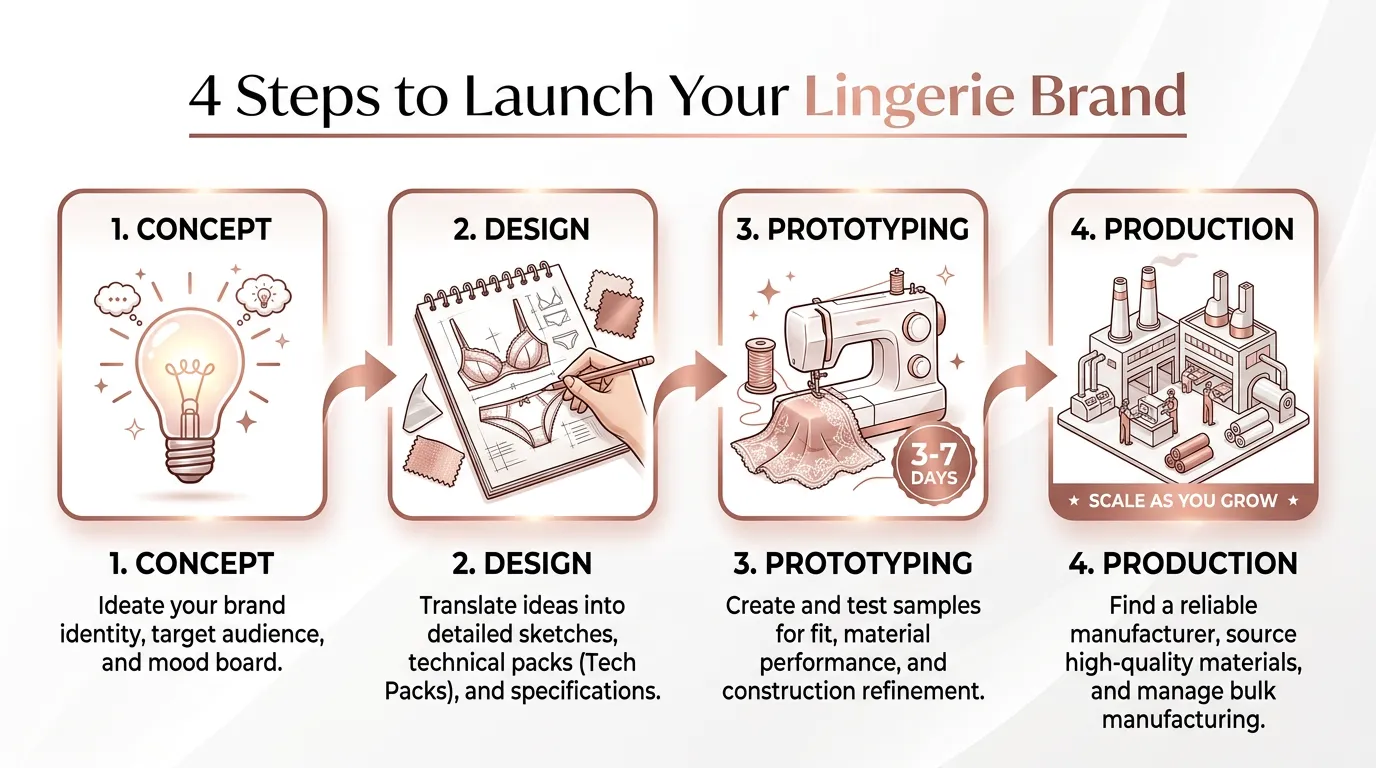
Creating a successful lingerie brand follows a clear process. Here's the roadmap from concept to customer:
Design → Material Selection → Sampling → Fit Testing → Production → QC → Delivery
Each step has specific requirements and decision points. Let's break them down.
Before reaching out to manufacturers, clarity is your competitive advantage.
Who are you serving?
What's your price point? This determines everything: fabric choice, construction methods, and minimum quantities. Be realistic—premium materials require different manufacturing capabilities than basic cotton.
What's your story? In a crowded market, your brand story matters. Are you solving a specific pain point? Bringing inclusive sizing? Revolutionizing comfort for a particular body type?
Manufacturers who understand your vision can become partners, not just producers.
Design is just one piece of the puzzle. If you need a complete business roadmap—from market analysis to finding the right manufacturing partner—read our guide: How to Start a Lingerie Business: The Complete Startup Roadmap
It covers:
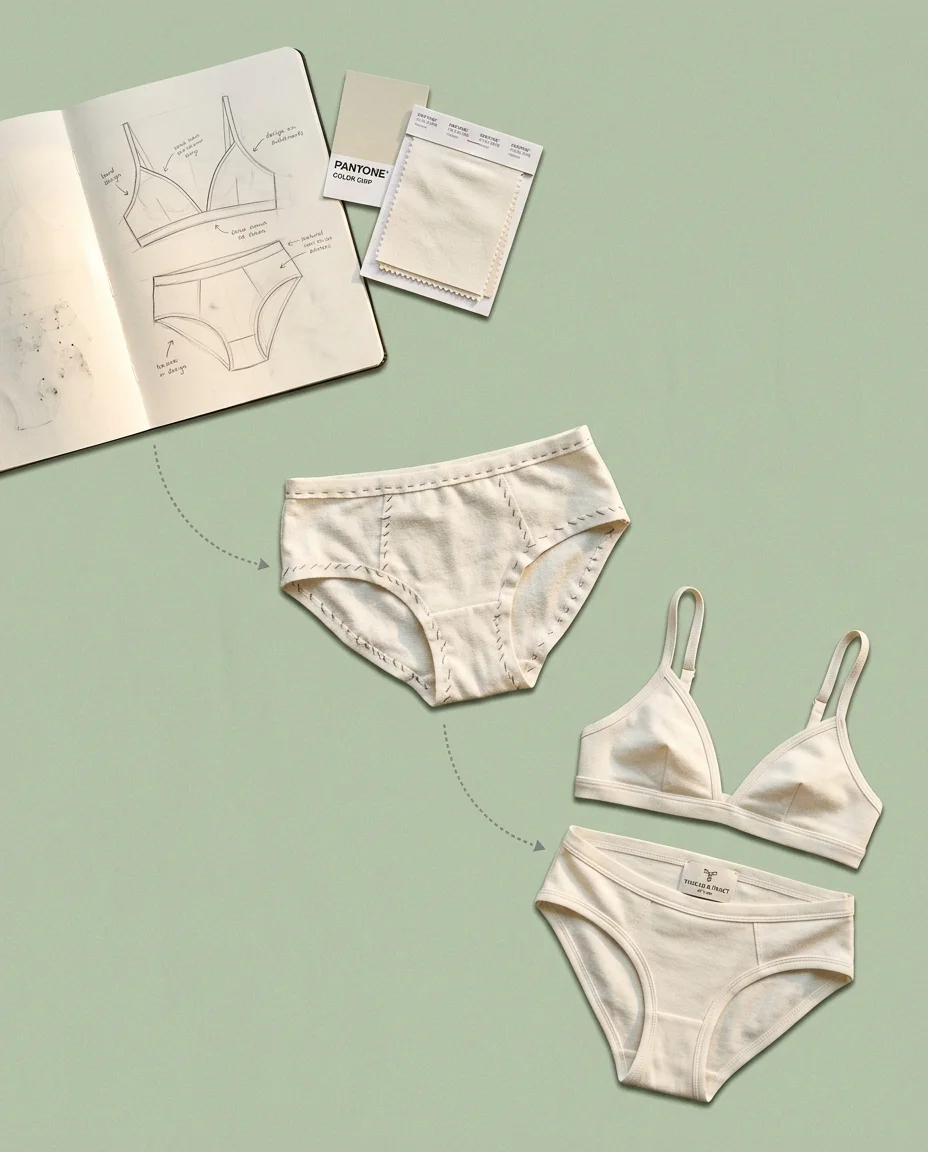
You don't need a full tech pack to start, but you do need clear communication.
If you have designs:
If you have reference samples:
If you only have a concept:
The right manufacturing partner can work with any of these starting points—but clarity about your vision speeds everything up.
Material selection is where comfort meets quality. The right fabric choices can make or break your brand.
Key Considerations:
Common Lingerie Fabrics:
For the science behind Modal vs cotton performance, see our Modal vs Cotton Underwear comparison.
For why 5% spandex is the industry standard, see our Spandex in Underwear analysis.
Pro tip: For critical construction details like the gusset, material choice is especially important. The gusset is the #1 driver of both 5-star and 1-star reviews.
Need deeper guidance on fabric selection? Check out our comprehensive Fabric Sourcing Guide for technical specifications and performance comparisons.
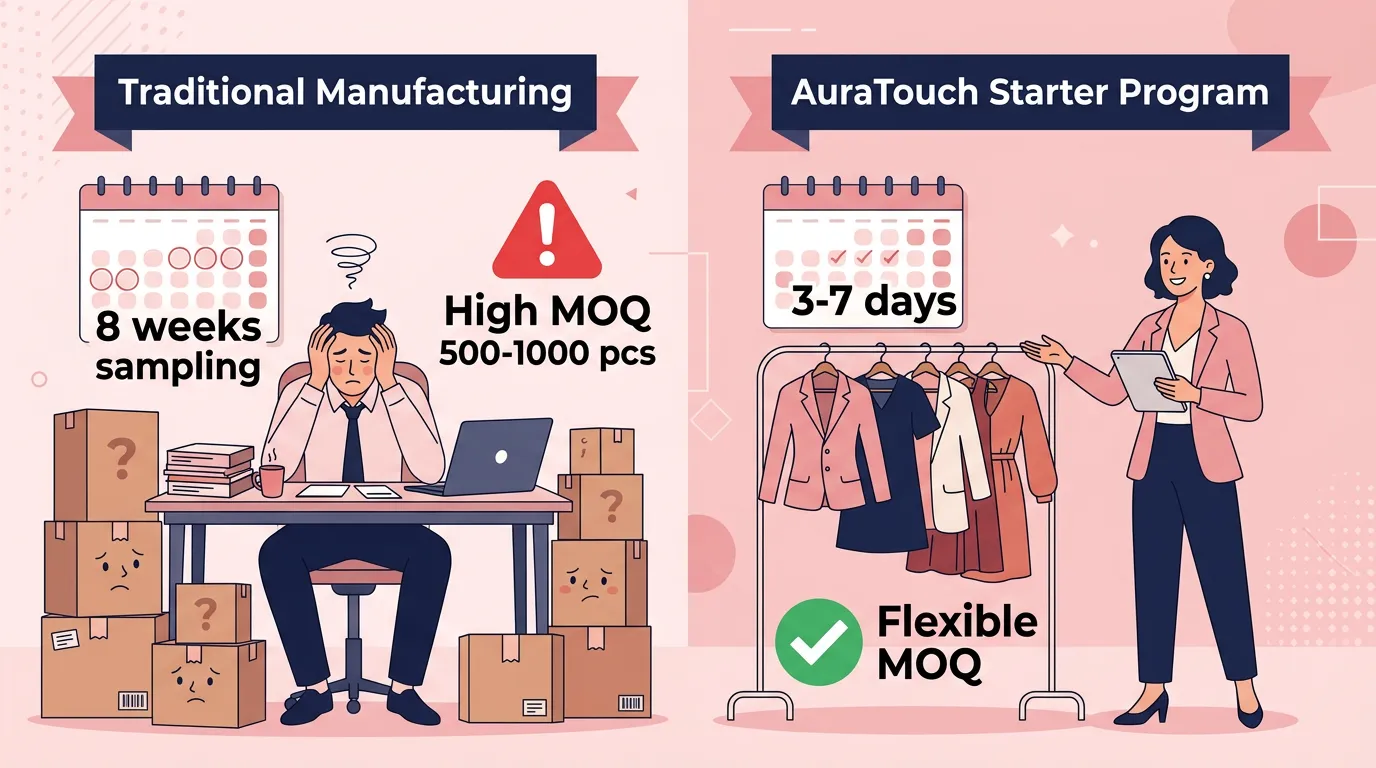
This is where most emerging brands get stuck. When you're looking for a custom lingerie manufacturer or underwear private label partner, traditional factories are set up for large orders, not small-batch experimentation.
What to look for:
The best partners for startups understand that you need to test the market before committing to large quantities. Look for manufacturers who offer:
In the lingerie business, fit is everything. You need to iterate quickly. A partner who can turn around samples in 3-7 days instead of 3-7 weeks gives you an enormous competitive advantage.
Traditional factories: 8-12 weeks for sampling Our approach: 3-7 days for rapid prototyping
This speed advantage lets you:
Can they explain technical trade-offs? Do they understand your brand vision? Are they proactive about suggesting improvements? You're not just buying production—you're partnering for expertise.
Ideally, choose a partner who can grow with you. Start small, prove demand, then scale production without switching manufacturers and re-qualifying quality.
Our factory is located in the Zhongshan-Xiaolan manufacturing cluster—China's underwear production hub. As a low MOQ underwear manufacturer specializing in small batch apparel manufacturing, this location gives your brand specific advantages:
For emerging brands, this translates to faster turnaround, more flexibility, and lower minimums than factories isolated from supply chain infrastructure.
Understanding the full pricing structure is essential for positioning your brand. Here is what happens to a $2 pair of underwear as it moves through the supply chain:
The opportunity for new brands is clear: the largest margin sits between wholesale and D2C retail. By working directly with a manufacturer and selling D2C, you capture the entire distribution margin. A $2 FOB product sold at $25 D2C yields significantly better margins than a $2 FOB product sold to a distributor at $5.
This is the stage where patience and precision pay off.
The Sample Iteration Process
What to test for:
Your manufacturer should be willing to iterate until the fit is right. This isn't about being difficult—it's about protecting your brand reputation.
Concerned about quality standards? Learn about fabric quality testing protocols that ensure your products meet customer expectations.
Once you've approved the final sample, you're ready for production.
Pre-Production Meeting Before production starts, have a detailed meeting confirming:
Quality Control For your first production run, consider:
Timeline Planning Account for:
Most consumers cannot articulate why one pair of underwear feels premium and another feels cheap. Often, the answer comes down to one manufacturing technique: four-needle six-line (四针六线) flat seaming.
3 threads, 1 needle. Creates a visible ridge on the inside of the garment. The seam is functional but creates friction against skin. Used in 80%+ of underwear under $10.
4 needles, 6 threads. Creates an ultra-flat seam that lies flush against the fabric. Nearly invisible against skin. Used in premium underwear above $15. The seam also stretches with the fabric, reducing stress on the stitching during wear.
Four-needle six-line stitching adds $0.05–0.10 per piece to manufacturing cost. It requires specialized machines and slower production speeds. But it is one of the most impactful quality differentiators that consumers feel immediately but cannot always name.
For your first production run, specify four-needle six-line stitching at minimum for the gusset attachment and waistband — the two areas where seam quality matters most for comfort.
For more on how gusset construction affects quality, see our guide to gusset design.
Unlike traditional manufacturers who focus solely on production, our process is designed for international export. We've integrated compliance checkpoints that prevent customs delays and ensure smooth market entry.
During the sewing stage, we go beyond basic quality control. Our process includes pre-compliance label review to ensure care labels meet destination market requirements.
Example: Indonesia Market (SNI Standards)
This proactive approach helps our clients avoid 50% of customs detention risks related to labeling non-compliance.
Our production management system integrates with export documentation. When orders are completed, we automatically prepare:
RCEP & Form E Benefits for Southeast Asia For clients targeting ASEAN markets, we prepare RCEP Certificate of Origin or Form E pre-declarations during packaging. This ensures:
This documentation integration transforms us from a simple manufacturer into a tax-optimized export partner.
At AuraTouchGlobal, we created our Starter Program specifically to address the pain points that kill emerging brands before they launch. With 15 years of experience serving China's top domestic lingerie brands, we're now bringing our manufacturing expertise to support international startups.
Our low MOQ structure isn't arbitrary—it's designed for data-driven market validation.
Our starter tier (160 pieces/color) is calibrated for TikTok-era rapid testing:
Traditional approach: Lock in 500-1000 units before any market feedback Our approach: Test market response with 160 units, iterate based on real data, then scale
This tiered structure transforms MOQ from a barrier into a market-entry strategy.
Contact our team for specific tiers based on your product type and target market. We'll help you design a testing protocol that minimizes risk while maximizing market insight.
Speed is your competitive advantage. Our dedicated R&D team works on a fast-track system for samples. From confirmed details to finished sample in your hands in as little as one week.
Traditional approach: 8-12 weeks for sampling rounds Our approach: 3-7 days per iteration
This rapid cycle lets you test more designs, respond to feedback faster, and get to market before competitors even finish their first sample.
Don't have professional technical drawings? Send us a high-quality reference image or a physical sample, and our pattern makers can replicate the fit and construction. We'll help you professionalize your design.
See something in the market that you love? We can work from photographs or physical samples to reverse-engineer similar styles—adjusted to your specifications and improvements.
Skip the fabric sourcing headache. Access our pre-sourced library of high-quality materials:
All materials are pre-qualified for hand-feel, durability, and production feasibility.
Start with quantities that make sense for testing. As your sales grow, our production lines scale with you seamlessly—from dozens to thousands of units, without sacrificing quality or switching partners.
Located in China's underwear manufacturing hub, our cluster location provides:
We believe in transparency and third-party verification. Rather than making unsubstantiated claims, we focus on what we can prove and coordinate:
We can coordinate and facilitate third-party testing for:
For detailed information on quality standards, read our guide on fabric quality testing.
A Southeast Asian lingerie brand was struggling with generic "Western-style" inventory that failed to resonate with local consumers.
We identified localization opportunities based on cultural and climatic factors:
Product Adaptation:
Export Compliance Support:
Despite a 125% increase in FOB cost (from $2.00 to $4.50 per unit), the localized product achieved:
Key Takeaway: Precise market adaptation + export compliance = premium pricing power with faster inventory turnover.
Need similar localization insights for your target market? Our team can advise on cultural adaptations and compliance requirements for Indonesia, Vietnam, Thailand, and other Southeast Asian markets.
The world doesn't need another generic lingerie brand. It needs YOUR vision—your unique take on fit, comfort, and style.
Don't let MOQ requirements, slow sampling, or manufacturing complexity stop you from launching.
Whether you have:
Our Starter Program is built to get you to market fast.
Looking for a reliable partner for your 2026 collection?
📥 Download our latest Product Catalog to see material options and production capabilities
📧 Request a free sample analysis — send us your design or reference, and we'll provide feasibility feedback and recommendations
💬 Get a custom quote for your first production run with specific MOQ tiers tailored to your needs
📋 Download "Indonesia/SE Asia Customs Clearance Checklist" — Our comprehensive guide covering SNI requirements, RCEP benefits, and documentation needed to avoid costly customs delays
We'll help you navigate the technical details, refine your designs for manufacturability, and create a lingerie brand that stands out in the market.
Contact us today to discuss your project. Limited spots available in our 2026 Starter Program—secure your production capacity now.
Your customers are waiting. Let's build something amazing together.
Compliance Notice: Export requirements (including SNI standards, RCEP rules, and Certificate of Origin eligibility) vary by product category, destination market, and current trade policies. We strongly recommend a pre-production consultation to ensure your specific order meets all applicable local standards and maximizes duty-free benefits.
Business insights for apparel brand owners, from production strategies to manufacturing optimization
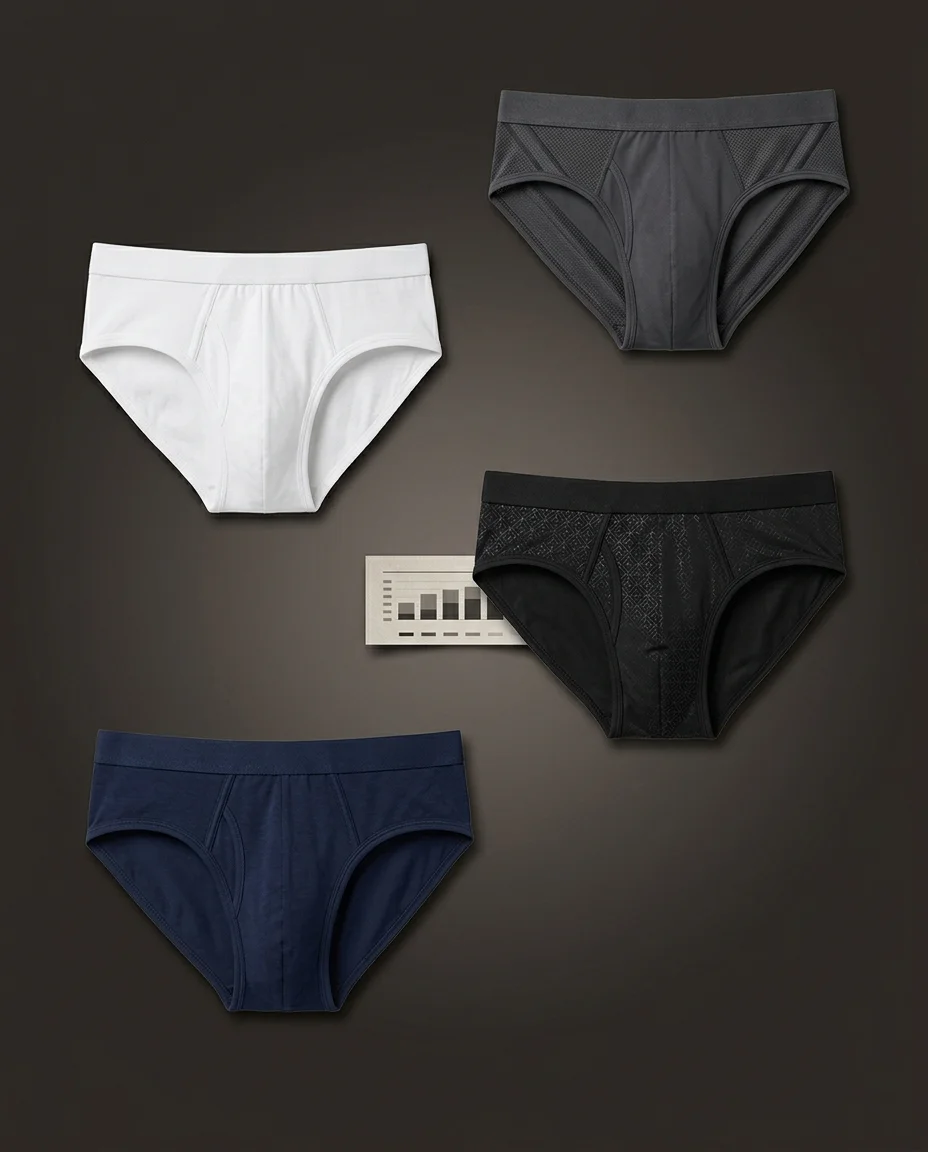
The men's briefs market is fragmenting from a single 'basics' category into four distinct competitive tracks. Traditional searches dropped 20-30%, while heated underwear (+2150%), seamless men's (+300%), and cooling fabrics (+180%) surge. This analysis breaks down four competitive tracks: budget basics, functional tech, premium fabrics, and performance sport — with pricing, technology requirements, and entry strategy for each.
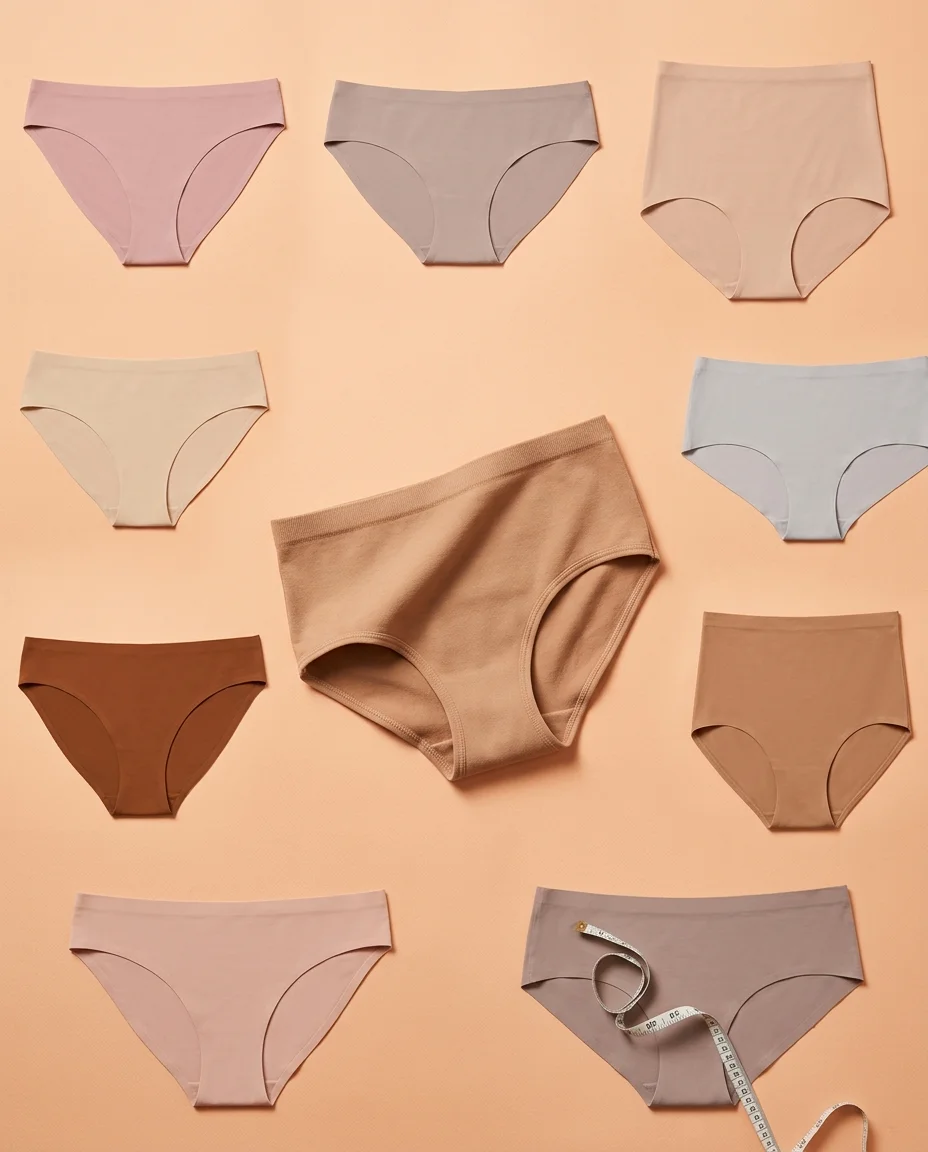
We tested 30+ seamless underwear brands across fabric recovery, waistband tension, and gusset construction. The results: only 6 brands use true circular knitting — most 'seamless' products are simply flat-lock seamed with marketing spin. This guide ranks the best seamless underwear by real performance data, not claims.
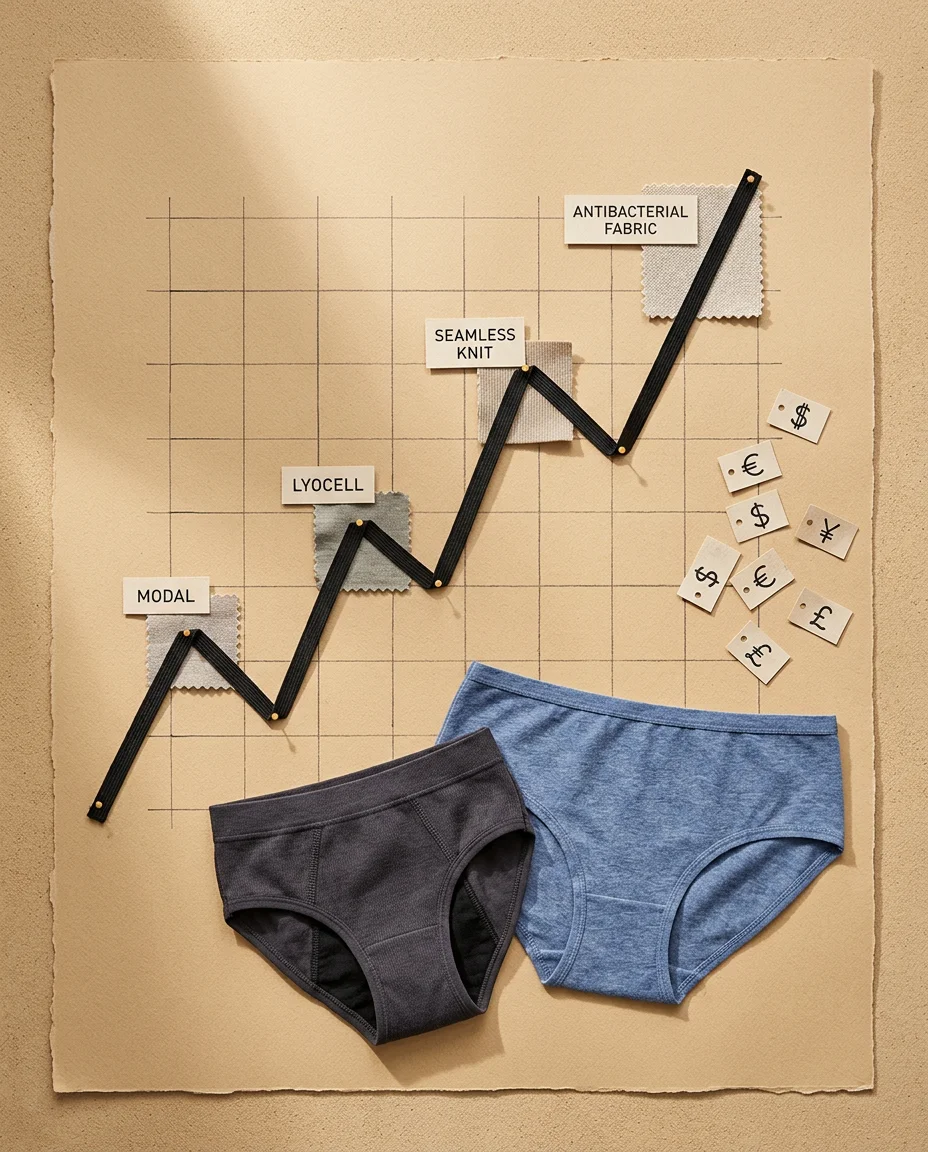
The underwear market is projected to reach $127.4B by 2032. We analyze 2026's trending products — period underwear (+300%), seamless (+110%), plus-size (+130%), and antibacterial Modal — with market data, fabric innovation timelines, and regional growth forecasts for brand planning.